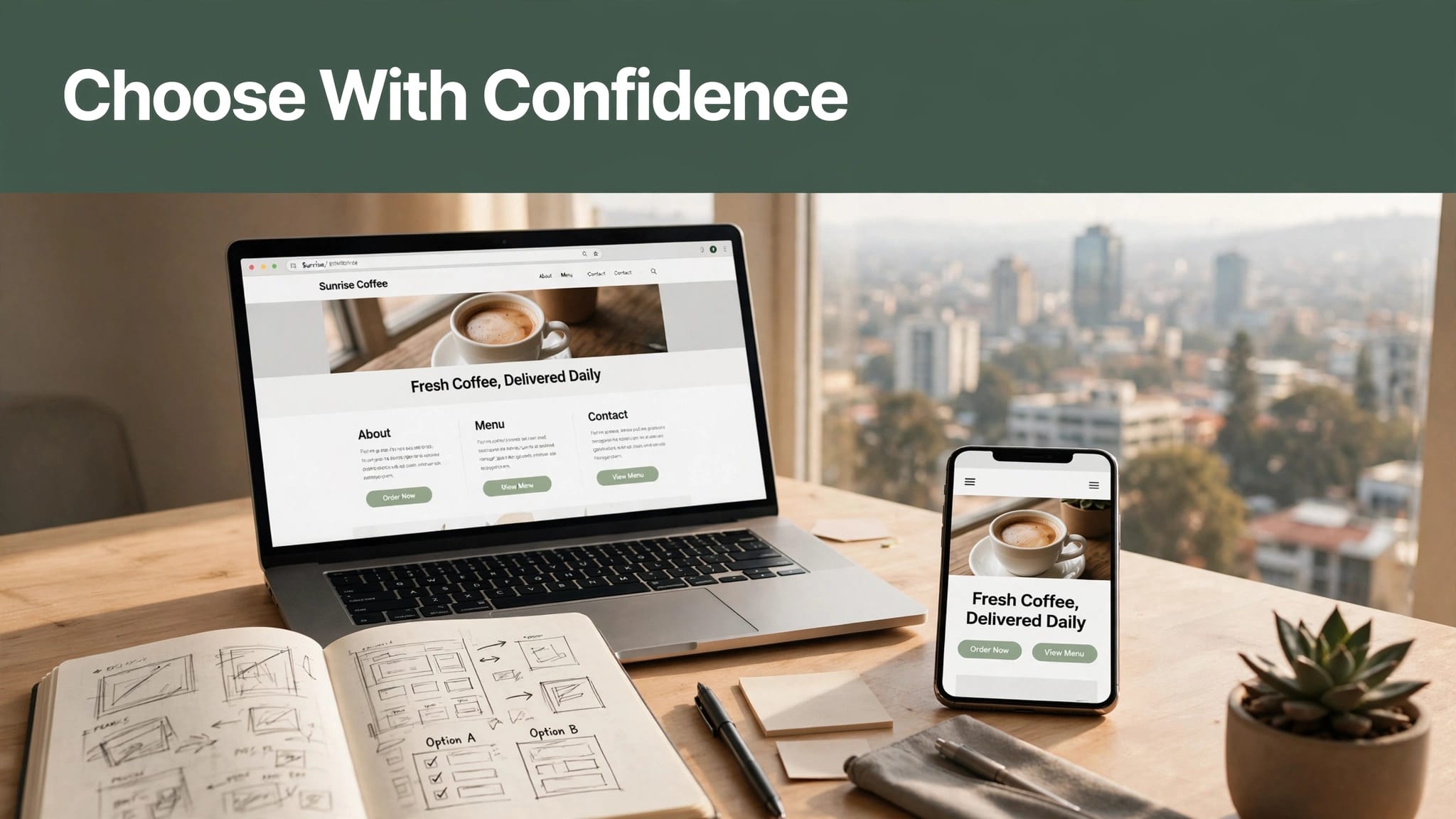
A good website makes it easy for customers to understand what you offer and take the next step, whether that means calling, booking, or paying. Choosing web developers in Nairobi is less about finding the flashiest portfolio and more about matching your project with people who can build, explain, and support the right solution.
You may be comparing freelancers, studios, and full-service agencies while trying to make sense of different quotes. I recommend starting with a clear brief, then judging each provider against the same needs, deliverables, and support expectations. That gives you a fair basis for choosing the right fit.
Key Takeaways
- Define the business problem, audience, features, and content before requesting proposals.
- Compare providers using the same written brief, then review working websites on a phone.
- Separate visual design, development, hosting, integrations, and ongoing support in each quote.
- Agree on milestones, payment terms, access, ownership, and handover before work starts.
- Identify who handles customer data, security, updates, and any required privacy obligations.
- Choose a developer who explains decisions clearly and can show how the finished site will be maintained.
What Web Developers in Nairobi Can Build
The term web developer covers a wide range of work. One provider may create a small company website using a content management system, while another builds a custom booking platform or online store. Before contacting anyone, find out which parts of the work your project actually requires.
Common services to compare
A typical project may include planning, page design, front-end development, back-end features, content setup, mobile testing, search engine basics, and launch support. Some web design companies in Nairobi also provide domains, hosting, email, cybersecurity, analytics, or digital advertising. Those services can be useful, but their presence on a brochure does not tell you what a specific quote includes.
Ask each provider to separate the work into clear deliverables. “Website development” might mean a custom build, a configured template, or a redesign of an existing site. The difference affects the scope, the process, and what you can change later.
Know when you need design, development, or both
Design is the structure and presentation people interact with. Development makes pages and features work. Some projects need both from one team; others need a designer to supply approved layouts to a developer.
If your brand needs new logos, illustrations, or product photography, ask whether those services are included. Graphic design companies in Nairobi may focus on brand identity and print work, while a web provider may specialize in layouts and code. Related skills can overlap, but one does not automatically include the other.
For a broader overview of available website development services, compare the service descriptions with the tasks in your brief.
Define the Project Before You Contact Developers
A developer can estimate and plan more accurately when you explain what the website must do. You do not need a technical specification. You do need a practical account of the business goal, the people who will use the site, and the actions they should be able to complete.
Start with the customer’s task
Write down what a visitor needs to find or accomplish. A school might need parents to find term dates and admissions information. A consultant may need visitors to understand their services and request a meeting. An online seller may need product pages, a stock process, delivery information, and payment options.
Then separate essential features from later additions. Mark the features required for launch and those that can wait. This helps prevent a simple project from expanding into an expensive list of unrelated extras.
Make a short, usable brief
A one-page brief can cover your business, audience, project goals, required pages, features, existing content, preferred launch window, and who will approve decisions. Include links to websites you like, but explain what you like about them. You might mean their navigation, page structure, or checkout flow, not a request to copy their appearance.
List what you already have, such as a domain, brand assets, product photos, or written copy. If you expect the developer to create these items, say so. A clear brief lets web designers in Nairobi respond to the same information rather than guessing at your needs.

Choose a Provider That Fits the Work
Nairobi has independent developers, small studios, and larger firms offering overlapping services. Their size alone does not tell you who will be right for your project. Compare the people who will do the work, the skills they bring, and the way they handle decisions and support.
Independent developer or studio
An independent Nairobi developer may offer direct communication and a focused working relationship. That can suit a small site with a clear scope. Ask how they handle design, testing, content, and urgent fixes if they work alone or have limited availability.
A studio may combine design and development roles, which can help when your project needs coordinated input. A larger firm may offer hosting, security, marketing, or business systems alongside website work. However, ask who will be your day-to-day contact and which specialists will actually work on the project.
Look beyond the label
Searches such as “web design Nairobi,” “Nairobi web designers,” or “best web designers in Nairobi” can surface many options, but these phrases do not establish quality or fit. The same goes for directories that group providers as Nairobi website designers, web designers Nairobi, or website designers in Nairobi Kenya.
I’d use search results to build a shortlist, not to make the final decision. Focus on verifiable work, a clear scope, relevant experience, and the provider’s answers to specific questions. A polished profile is a starting point, not evidence that the team can deliver your particular project.
Match the Team to the Project’s Complexity
A five-page information site and a platform with user accounts, payments, or custom reporting require different levels of planning. A good fit depends on complexity, the amount of coordination required, and what you will need after launch.
When a small team may be enough
A small business site with standard pages, contact forms, and straightforward content may not need a large development team. A capable freelancer or compact studio could cover the work if the scope is clear and the handover is documented.
Ask who is responsible for each task. If one person handles design and development, find out how they test the result and what happens when they are unavailable. A small team can be efficient, but you still need a continuity plan for passwords, backups, and support.
When a wider team can help
More complex projects may involve a designer, developer, content specialist, payment integration expert, or security professional. In that case, ask who coordinates the work and who accepts responsibility for the complete result.
Some clients search for web development companies in Nairobi or web development companies in Kenya because they need several capabilities under one agreement. The label matters less than the assigned roles. Ask for a named point of contact, a decision process, and a written account of how each team member contributes.

Consider the Nairobi Audience and Use Case
Local context matters when it affects how people find, use, and pay through your site. A Nairobi-based audience may include customers using different phones, browsing conditions, and preferred ways to contact a business. The developer should ask about those details rather than assume one layout or payment flow fits everyone.
Design for mobile use
Review the proposed site on a phone, not only on a large monitor. Text should be easy to read, menus should be usable, and forms should not require unnecessary typing. Images should suit the screen and load efficiently, especially when visitors have limited bandwidth.
Ask the developer how they test mobile layouts and what they do when a page becomes slow. Look at important pages yourself on more than one screen size. For example, test the route from the home page to a service, then to the contact or booking action.
Choose contact and payment flows carefully
Your audience may expect to call, send a WhatsApp message, fill out a form, or pay online. Identify the route that fits your sales process. If you need M-Pesa, discuss the exact transaction flow, settlement, order confirmation, refunds, and how staff will see payment status.
An STK Push flow can ask a customer to confirm a payment on their phone. That is different from adding a generic payment button. Ask the developer to explain what the customer sees, what happens if a payment fails, and how the system records a successful transaction.
Compare Web Design and Development Services
When comparing web design services in Nairobi, examine the whole delivery process, not just the first screen. A provider might use the term “website design” for a package that includes development, or for visual mockups only. Ask which stages and outputs the fee covers.
Ask what is included
A proposal should state how many page types are being designed, who supplies text and images, how many review rounds are included, and whether the site will be built on a content management system. It should also say whether forms, analytics, search engine setup, accessibility checks, and training are part of the project.
In addition, request a clear description of third-party services. A domain, hosting plan, premium theme, payment gateway, or external booking tool may have separate renewal costs. These items should not appear as surprises after you approve the build.
Compare like with like
Send the same brief to each shortlisted provider. Then compare proposals by deliverables, exclusions, schedule, support, and the assumptions each provider has made. A lower quote may omit content entry or post-launch fixes, while a higher one may include services you do not need.
You can review website design services in Nairobi to see how design and practical site features can be described. Use that kind of service breakdown to ask focused questions, rather than treating a general package name as a complete specification.
Assess Portfolios and Technical Quality
A portfolio should help you judge the provider’s work, not just its ability to produce attractive screenshots. Ask for live examples and examine the pages that matter to your own project. A site that looks good in a static image may still have confusing navigation or a broken form.
Test real visitor journeys
Open a sample site on your phone. Try the main tasks a customer would perform: finding a service, locating a price or policy, submitting a form, or completing a purchase. Notice whether the page gives a clear next step and whether the site remains usable when you scroll.
For an online shop, test product discovery, cart behavior, checkout, and confirmation. For a service business, check contact details, enquiry forms, and appointment requests. These checks are more informative than asking whether the developer has used a particular visual trend.
Ask about the team’s contribution
Find out whether a portfolio item was designed and built by the provider, adapted from a theme, or completed with another agency. Those approaches can all be suitable, but you need to understand what the team did and whether the project resembles yours.
Ask how the site handles content updates and whether it has been maintained since launch. If a provider shares work from a range of industries, check for consistent usability and not only varied visual styles. A focused portfolio may be more relevant than a long list of unrelated projects.

Check the Technology and Content Workflow
You do not need to choose a framework or write technical requirements before speaking with a developer. You should understand what platform the provider proposes, why it suits your project, and how you will manage the site after launch.
Ask how you will update the site
If you expect to add news, products, staff details, or event dates, ask who will make those updates. A content management system may let your team handle routine edits, but you need to know what training and permissions are included.
Ask the provider to demonstrate a typical update using sample content. Find out whether ordinary edits require code changes or a developer’s help. Also clarify what happens if you decide to move the site or change providers later.
Understand the technical choices
Ask why the proposed platform fits the site’s needs. For example, a standard content site may not require a custom application, while a booking workflow or account area could call for specific development. The provider should explain the trade-offs in language you can use to make a decision.
Clarify how the site will handle backups, software updates, security fixes, and compatibility changes. If the provider recommends third-party plugins or services, ask who will manage their renewals and updates. Those details matter because a website continues to depend on its software after launch.
Ask About Hosting, Domains, and Support
A website needs a place to run, a domain that points to it, and a plan for problems that arise. These responsibilities may sit with the developer, a separate host, or your own team. Know who controls each service before you approve the project.
Identify the service owner
Ask whose account will hold the domain, hosting, email, and any paid software licences. If the provider registers a domain for you, make sure your business has appropriate access and the renewal process is clear.
Hosting is also a separate decision from development. Ask what the plan includes, how backups work, and how you can retrieve a copy of your site. For more on the distinction between service types, see our overview of website hosting services in Kenya.
Define support in plain language
“Support included” can mean many things. Ask whether it covers technical faults, content changes, security updates, or only assistance with the hosting account. Find out how to report a problem, who responds, and whether routine maintenance is billed separately.
A useful support agreement names the service, the communication channel, the coverage period, and the types of work included. It should also explain how larger changes are estimated and approved. This helps you distinguish a defect fix from a new feature request.
Compare Proposals Without Guessing
A proposal is more useful when it makes assumptions visible. Read it beside your brief and mark each requirement as included, excluded, or unclear. This exposes gaps before they become disagreements.
Look for a complete scope
A clear proposal identifies the pages or page templates, features, content responsibilities, integrations, testing, launch tasks, and handover materials. It also states what the developer expects from you, such as access to brand assets or timely approval of drafts.
If a proposal uses broad phrases such as “SEO included” or “secure website,” ask what work those terms describe. Search visibility may involve technical setup, content, or ongoing promotion. Security may mean routine configuration or a continuing maintenance service. Ask for specific outputs.
Compare the shape of the offer
A side-by-side table can make differences easier to see. Fill it with the actual items each provider commits to, rather than generic scores.
| Proposal item | Questions to answer |
|---|---|
| Design | How many page types and revision rounds are included? |
| Development | Which features and integrations will work at launch? |
| Content | Who writes, edits, and uploads the text and images? |
| Hosting | Which account holds the service and what does it include? |
| Testing | Which devices, forms, and user journeys will be checked? |
| Support | What fixes and maintenance are covered after launch? |
The strongest proposal is the one that fits your requirements and makes responsibilities clear. A total price by itself does not tell you whether two providers are offering the same result.
Ask Questions That Reveal Project Fit
The first meeting should be a working conversation, not a presentation where you listen to general promises. A suitable developer will ask about your customers, your business process, and the tasks the site must support.
Questions about process and decisions
Ask who will lead the project, how you will review designs, and what happens when a decision is delayed. Find out how the team records feedback and resolves conflicting requests. If several people must approve the work, explain that early.
You can also ask how the provider handles a feature that proves more complex than expected. A good answer explains how the issue is documented, costed, and approved before the team changes scope. It should not depend on informal conversations alone.
Questions about completion and support
Ask what must be true before the site is considered ready to launch. The response should cover more than the appearance of the home page. It may include working forms, mobile checks, content approval, access transfer, and training.
Then ask who you contact after launch and what kinds of work require a new quote. These questions help distinguish ongoing maintenance from one-time delivery. They also reveal whether the developer expects to leave you with a usable site or a long list of unresolved tasks.
Understand Pricing and Project Costs
There is no single price that applies to every website. The cost depends on the scope, design needs, content, integrations, revisions, hosting, and support. Avoid comparing a fixed amount from one provider with an incomplete quote from another.
Ask for a breakdown
Request a written breakdown that separates the initial build from recurring services and third-party charges. The proposal should identify the work covered by each amount and the payment points tied to delivery. If content writing, product uploads, or migration are extra, they should appear clearly.
Do not assume the lowest price is best value or that a high price guarantees quality. Instead, compare the work you receive, the provider’s relevant examples, and the cost of keeping the site operational. If you must reduce the budget, ask which features can move to a later phase without weakening the core website.
Treat salary searches as context, not a quote
People searching for a web developer salary in Kenya or a web designer salary in Kenya may be trying to understand how provider fees are set. However, a salary figure is not the same as a project quote. A project fee can include planning, equipment, licences, tax, administration, specialist work, and support beyond the time spent writing code.
The same caution applies when looking at web design jobs in Nairobi or job listings to assess talent. Those listings can show the range of roles in the market, but they do not establish a freelancer’s project cost or a firm’s service quality. Ask for a project-specific estimate instead.
Put Scope, Milestones, and Payments in Writing
A written agreement gives both sides a shared account of the work. It does not need to be difficult to read. It should make clear what will be delivered, how changes are handled, and what happens if a dependency or approval is delayed.
Define the stages
Break the project into phases such as discovery, design, development, testing, and launch. For each phase, state the expected output and how you will approve it. A design approval, for example, should identify what the team is building from that point forward.
Set a schedule with decision points, not just a hoped-for launch date. You may need to provide text, images, product details, or access to existing systems. Make those responsibilities explicit so neither party assumes the other will handle them.
Tie payments to agreed work
The agreement should show the payment schedule, the amount due at each stage, and what event triggers an invoice. It should also explain how new requests are priced and approved. If a requested change affects timing, record the revised schedule.
Ask what happens if the work pauses or ends early. The written terms should describe payment for completed work and transfer of the materials created to that point. Clear terms protect the working relationship because both parties can refer to the same expectations.

Agree on Ownership and Handover
A website can look finished while essential access remains with the provider. Before the project begins, decide who owns the domain, hosting account, source files, design assets, content, and any custom code. The agreement should also explain which third-party tools have their own licence terms.
Keep practical control of accounts
Use a business-controlled email address for core services where possible. Ask the developer to list the accounts involved and state who creates and administers each one. Your team should know how to access the domain, hosting dashboard, content system, analytics, and payment tools.
Agree how passwords and administrative access will be transferred securely. A handover should not rely on one person remembering a list of credentials. It should include access instructions and a clear process for changing accounts when a staff member or supplier leaves.
Request usable handover materials
Handover may include administrator access, backups, a list of paid services, documentation, and training for routine updates. Ask which items are included and in what format. If the site depends on custom integrations, request enough documentation for another qualified developer to understand the setup.
Clarify whether a provider retains a copy of project files and how long they keep it. You should know how to obtain your own backup and what happens to stored data when the relationship ends. The goal is continuity, not dependence on an undocumented setup.
Protect Customer Data and Privacy
A website may collect names, phone numbers, email addresses, payment details, or information submitted through forms. If it does, data handling should be part of the project conversation, not a final check after launch.
Identify the roles and data flows
Ask what information the site collects, why it collects it, where it is stored, and which people or services can access it. Your business may decide why customer data is collected, while a developer or host may process it on your instructions. The exact roles depend on how the services are arranged.
Kenya’s Office of the Data Protection Commissioner provides information for organizations handling personal data. Its ODPC FAQs on registration describe registration requirements and exemptions. The rules do not mean every developer has the same status, so discuss the actual data roles for your site.
Put safeguards into the build
Ask how the provider will protect administrator accounts, restrict access, back up the site, and respond to a suspected incident. For forms and customer accounts, ask which data fields are necessary and how long the information will be retained.
The ODPC’s guidance on registering data controllers and processors can help you understand the registration framework. Keep the project agreement clear about each party’s tasks, access, and responsibilities for personal data.
Plan Invoicing and Supplier Administration
Project administration is easier when the supplier paperwork is discussed early. Ask how the provider invoices, what business details they need from you, and whether the quote separates professional services from subscriptions or other expenses.
Keep a clear payment record
For each payment, retain the approved proposal, invoice, proof of payment, and any written change to the scope. If an invoice covers a milestone, the milestone should match the agreement. This gives your finance team a clear trail if the project spans several months.
The Kenya Revenue Authority’s eTIMS system concerns electronic tax invoicing for businesses. When you review supplier paperwork, include the invoice format and business details in your administration process. Keep this separate from the technical evaluation: an orderly invoice does not prove that the provider’s scope is suitable.
Separate project fees from renewals
A build fee and recurring costs are different commitments. Ask which services renew, who pays the renewal, and what happens if you cancel. This may include hosting, domains, email, premium software, stock photography, or external payment services.
Record renewal dates and account owners in your own business records. If a developer pays for a service on your behalf, state how they will notify you of renewals and price changes. That prevents a website from going offline because an account or subscription was overlooked.
Prepare for Testing and Launch
Launch should follow a defined acceptance process. Before the site goes live, you and the developer should review the key pages, test core functions, and confirm that the business has the access and materials it needs.
Test the tasks customers care about
Try the site as a visitor. Use a phone to find a service, submit an enquiry, request a booking, or complete a purchase. Check that confirmations arrive, contact details are correct, and links lead to the intended pages.
Also review the site on a desktop and check common browsers. Test forms with realistic entries and confirm that the right person receives each submission. If your site accepts payments, agree how the team will test the payment journey without confusing test transactions with real orders.
Agree what “ready” means
Write down launch requirements, including approved content, working features, access transfer, backups, and any required redirects from an older site. Identify who gives final approval and who will be available during the launch window.
A launch plan should include a way to report problems and a person responsible for each task. The developer should explain what to do if a critical feature fails. Once the site is live, schedule a short review so issues found in normal use can be recorded and handled.

Decide What Happens After Launch
A website needs care after launch. Software changes, content becomes outdated, and business needs shift. Before hiring, decide whether you want a one-time build, a maintenance arrangement, or a provider available for occasional work.
Separate maintenance from new features
Maintenance can include updates, backups, security checks, and fixes for defects. A new booking function, additional landing page, or redesign is usually a separate project. Ask the provider to describe the boundary between routine care and new development.
Find out how often maintenance tasks occur, what report you receive, and how you can request work. If the site is hosted by the same provider, ask how hosting support differs from website maintenance. Those responsibilities can overlap, but a clear agreement makes them easier to manage.
Keep an exit route
Even if you expect a long relationship, plan for a change of supplier. You should have access to your accounts, a current backup, and enough documentation for another developer to take over. Ask whether the provider charges for handover assistance and what materials are included.
At Nairobi Web Experts, we work across web development and hosting, cybersecurity, and business solutions. Our office is at Karen Plains Arcade in Nairobi. If you are comparing providers, consider whether that combination matches your needs, then evaluate it against the same scope and support questions you ask of every shortlisted team.
Avoid Common Hiring Mistakes
A rushed choice often starts with an incomplete brief or a decision based on one attractive mockup. You can reduce avoidable friction by documenting requirements and treating sales claims as questions that need specific answers.
Watch for vague promises
Be cautious when a provider cannot explain what is included, who is doing the work, or how they will handle changes. A promise of “everything included” is not useful unless the proposal defines everything. The same applies to broad claims about rankings, traffic, or sales.
Ask to see relevant working examples and request a direct explanation of the provider’s role in each one. If the answer shifts when you ask about ownership, maintenance, or payment stages, pause the decision until the terms are clear.
Avoid choosing by price or design alone
The cheapest quote can leave out essential work, while the most polished design may hide weak usability. Compare evidence across the full project: the brief, portfolio, process, accessibility, testing, handover, and support.
Search phrases such as “Nairobi website designers,” “website designers in Nairobi,” or “website design Nairobi” can help you find options. They cannot tell you whether a provider will communicate well or deliver the right features. Choose based on the fit between the documented work and your business priorities.
Use Local Search Terms to Build a Shortlist
People use different phrases when looking for help. You may search for a Nairobi website developer, Nairobi web developers, website developers in Nairobi, or web development Nairobi. Others may search for a development house in Nairobi or for Kenya web designers in Nairobi. Treat these as different routes to possible providers, not as quality rankings.
Search by the work you need
Add the project type to your search: ecommerce, booking site, business website, or web application. This can narrow the results to providers whose work resembles your requirements. If your project needs a special integration, ask about that capability directly rather than relying on a generic service page.
Search results may also lead to companies that combine design, hosting, and business technology. A provider may describe itself as a digital agency or a cloud-focused web team. Those labels do not replace the essential questions about who builds, who supports, and what the proposal includes.
Compare local and remote options fairly
A local provider can make in-person meetings easier, but location alone does not guarantee a better outcome. Remote developers can also work effectively when the scope, review process, and communication channels are clear.
If face-to-face meetings matter to you, ask where the project team works and how often meetings are available. Otherwise, compare all candidates by the same criteria. For background on local provider selection, our guide to website developers in Nairobi offers another perspective on the available services.
Frequently Asked Questions
What should I ask a Nairobi web developer first?
Start with who will do the work, what the proposal includes, what you need to provide, and how support works after launch. Then ask for relevant live examples and a clear explanation of the project process.
Should I hire a freelancer or an agency?
Choose based on project complexity and the skills required. A freelancer may suit a focused build, while an agency can coordinate several specialties. In either case, confirm who is responsible for each task and how support continues if a team member becomes unavailable.
Do I need a separate designer and developer?
Not always. Some teams handle both design and development; others divide the work. Ask for samples of each capability and confirm who will turn approved layouts into a functioning, tested website.
How can I compare website quotes fairly?
Give each provider the same written brief. Compare deliverables, exclusions, content responsibilities, integrations, revisions, hosting, testing, handover, and support. A headline price is meaningful only when you understand what it covers.
What should I receive when the website is complete?
Agree on the handover before work begins. It may include administrator access, domain and hosting details, backups, training, documentation, and a list of paid services. The exact materials depend on the platform and agreement.
Choose the Partner Who Makes the Work Clear
The right developer is the one who can connect your business goals to a defined scope, explain technical choices in plain language, and support the site beyond its first day online. Compare providers against the same brief, test the work on real devices, and settle ownership and responsibilities in writing.
When those details are clear, you can choose with confidence and build a website your team can manage. A strong project starts with a clear agreement about what the site must do and who will keep it working.