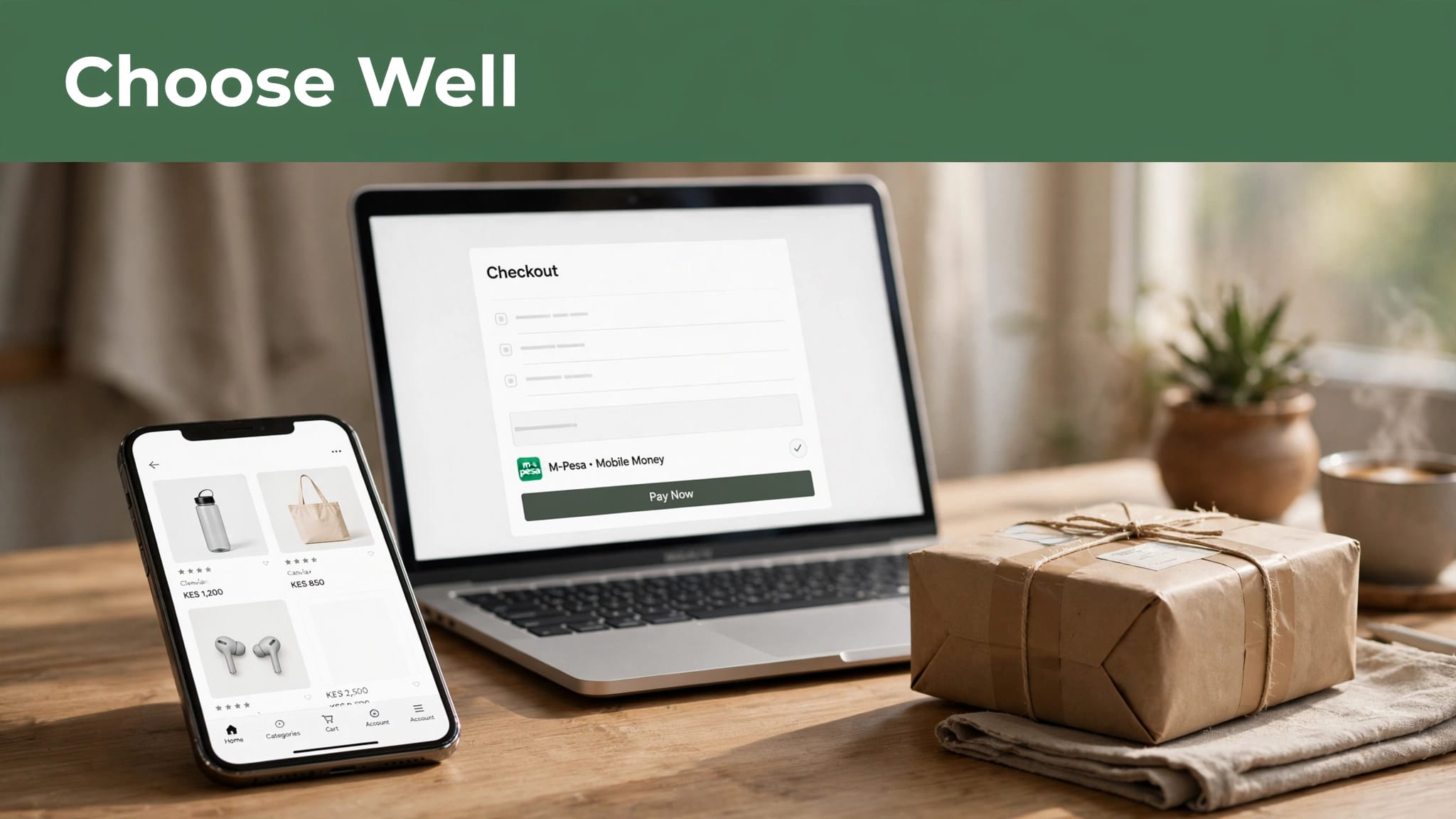
A good online store has to do more than look polished. It must help customers find products, pay in a familiar way, and understand when an order will arrive. If you’re comparing e-commerce website developers in Kenya, judge the whole buying experience, not just the homepage.
The right developer will connect your catalogue, checkout, payments, delivery process, and support plan. I recommend comparing those parts against your actual needs before you accept a quote. Start by defining what your store must do on launch day.
Key Takeaways
- Choose a developer who can show live stores with working product pages, checkout, and mobile layouts. A collection of attractive screenshots doesn’t prove those parts work.
- Ask for a written scope covering product limits, payment methods, order management, delivery rules, SEO setup, training, hosting, and support.
- Treat M-Pesa as a specific integration requirement. Ask whether the proposal covers STK Push, payment confirmation, failed transactions, and order matching.
- Compare total cost, not just the build fee. Include gateway charges, hosting, domains, maintenance, product entry, and any paid software.
- Keep control of your domain, store, payment accounts, customer records, and analytics. Your business should be able to access them after launch.
What an E-Commerce Website Developer Should Build
An online shop is a working sales system. Its pages need to guide a customer from product discovery to a clear order confirmation, while giving your team a reliable way to manage what happens next.
The storefront and catalogue
A developer should help structure product categories, product pages, search, filters, stock status, and product variations such as size or colour. The best structure depends on what you sell. A shop with a small range of handmade goods needs a different catalogue from a wholesaler with hundreds of products and frequent stock changes.
Each product page should present useful details, clear prices, good images, availability, and delivery information. If the customer needs to contact you before ordering, the site can support that too. The design should make the next step obvious without hiding key conditions in fine print.
The order process behind the pages
After checkout, someone needs to see what was ordered, whether payment succeeded, and where the order stands. Ask how the build will handle stock updates, order notifications, customer accounts, refunds, discount codes, and reporting. These functions matter even when the site looks simple from the outside.
A developer may describe the work as web design, web development, or a complete ecommerce build. Focus on deliverables rather than labels. Our e-commerce development guide for Kenya outlines common local-store features, including mobile payments, catalogues, and order management.

Why Local Context Matters in Nairobi
A local team can make it easier to discuss your customers’ payment habits, delivery areas, product language, and support needs. It can also help when you prefer a face-to-face planning meeting. Still, a Nairobi address alone doesn’t tell you whether a provider can build the store you need.
Searches such as “web design Nairobi,” “Nairobi web designers,” or “website designers in Nairobi Kenya” can return freelancers, agencies, graphic design studios, and marketing firms. Some focus on branding and visual design, while others build payment flows and inventory tools. Ask who will handle each part of your project.
A search result that calls a provider one of the “best web designers in Nairobi” is a marketing claim, not a comparison method. Look for relevant, working stores and specific technical details. A Nairobi developer should be able to explain how the project team will manage mobile checkout, payment status, delivery information, security, and handover.
Terms such as Nairobi website developers, web developers in Nairobi, and web development companies in Kenya can describe different kinds of providers. A solo developer may be suitable for a small catalogue. A larger build could need design, development, testing, and ongoing support from more than one person.
Career searches have a different purpose. Queries about web design courses in Nairobi, web design jobs in Nairobi, web designer salary in Kenya, or web developer salary in Kenya won’t tell you whether a vendor’s ecommerce package fits your business. For hiring, assess the people and capabilities assigned to your build.
Separate Visual Design From Store Development
Visual design affects trust, but a handsome page cannot compensate for a broken checkout. When comparing web designers in Nairobi, web designers Nairobi, or web design companies in Nairobi, ask what technical work sits behind the design.
What a designer contributes
A designer shapes the visual system, page layouts, typography, image treatment, navigation, and product presentation. Those choices should suit your products and make the store easy to use. A graphic design company in Nairobi may be a good fit for branding, product photography direction, or campaign artwork.
However, branding work isn’t the same as building ecommerce functionality. A graphic design company may not provide payment integrations, order management, stock controls, or security maintenance. Ask which team delivers those features and who takes responsibility when they fail.
What a developer contributes
A developer connects the parts that make a store function: the content system, catalogue, payment service, order records, shipping rules, and analytics. A project can include both design and development, but the proposal should name each deliverable.
We offer website development, hosting, cybersecurity, SEO, and business solutions. When we scope an ecommerce project, the practical question is how those services fit the store’s requirements, not whether a provider uses a broad service label. Our guide to choosing web developers in Nairobi gives more context on evaluating a development team.
Choose a Platform That Fits the Business
The right platform depends on catalogue size, staff skills, integrations, budget, and how much control you need. Ask the developer to explain why a particular option suits your business rather than treating one platform as the answer for every store.
Hosted platforms and managed systems
Shopify is a hosted ecommerce platform. It can suit a business that wants a managed store environment and a defined set of tools. The build still needs careful planning for products, checkout, payments, delivery, customer emails, and reporting.
A hosted system can reduce the amount of server administration your team handles, but it doesn’t remove ongoing costs. Consider subscription fees, paid themes or apps, payment charges, and any work needed to configure or maintain integrations.
WordPress, WooCommerce, and custom builds
WooCommerce adds ecommerce features to WordPress. It can suit businesses that want flexible content and store management, though themes, plugins, hosting, and updates need ongoing attention. Ask who will test plugin updates and restore the store if an update breaks a key function.
Magento, now associated with Adobe Commerce, can support more complex catalogue and operational needs, but it can require more implementation and maintenance work. A custom build may make sense when you have requirements that off-the-shelf tools can’t handle efficiently. Otherwise, custom code can add cost without improving the customer experience.
Before you choose, ask for a feature map: which platform will handle each need, which functions depend on third-party services, and what the business will pay to keep them running.
Assess a Developer’s Portfolio With Care
A portfolio is most useful when it shows work close to your project. A restaurant ordering site, for example, won’t prove that a developer can handle product variations, stock control, or a larger catalogue.
Inspect live stores
Open the sample stores on your phone, not only on a desktop. Visit product pages, use the menu, add an item to the cart, and follow the checkout as far as the site allows. Look for clear prices, working links, readable product details, and a sensible response when an item is unavailable.
Ask the provider to identify what their team built. A portfolio may feature a site where the agency handled only the visual design, while another company built the backend. That division matters if you expect one team to support the full store.
Ask what the work involved
Ask how the example handled payments, catalogue structure, order notifications, and mobile performance. If the provider can’t share private client details, they can still explain the type of work and show features that are publicly visible.
Compare a few relevant projects rather than counting portfolio entries. Nairobi web designers and website designers in Nairobi can have different strengths, so check whether the work matches your sales model. We suggest using the website developer hiring guide for Nairobi to structure the conversation.

Make Mobile-First Design a Requirement
Many customers will reach your store on a phone. A mobile-first build puts the small screen at the centre of the design process, rather than shrinking a desktop layout after the fact.
Check that product names and prices are easy to read, buttons have enough space, and the cart is easy to find. Product images should load at an appropriate size. Menus should be simple to use with a thumb, and checkout should avoid asking for details the business doesn’t need.
A good developer should test pages across common screen sizes and browsers. Ask how the team will check image weight, layout shifts, and loading performance on a slower connection. This is particularly important for a customer using mobile data on a mid-range device.
Mobile design also affects the way people pay. If a customer needs to switch apps, enter an account number, or decipher unclear instructions, checkout can become frustrating. The phone experience should make the payment step and the next order status easy to understand.
Don’t accept “responsive” as the complete explanation. Ask the developer to demonstrate the product page, cart, and checkout on a phone. Then consider whether your staff can manage orders and stock without relying on a desktop for every task.
Plan M-Pesa and Other Payment Integrations
For many Kenyan stores, M-Pesa is central to checkout. Still, the words “M-Pesa integration” can describe different payment paths. Your proposal should state which method it includes and how the site will know whether a customer paid.
Ask about the payment flow
Safaricom’s Daraja Developer Portal provides access to M-Pesa APIs for web and mobile integrations. A developer can use Daraja for a payment flow such as STK Push, where the customer receives a prompt on their phone. The project also needs to handle the response and update the order correctly.
Ask what happens if a customer cancels the prompt, payment fails, or the callback arrives late. The store should not mark an unpaid order as paid simply because the customer clicked a button. It should also avoid creating duplicate orders when a customer retries.
“SIM card toolkit” and “STK” can refer to SIM-based technology, while M-Pesa STK Push is the specific ecommerce payment flow many businesses mean. Name the exact feature in your brief. Our guide to M-Pesa STK Push integration covers relevant setup and security considerations.
Compare gateways and fees
A gateway can provide access to M-Pesa, cards, or other methods through an integration. IntaSend publishes an M-Pesa API integration guide, while Pesapal offers payment services for businesses. Compare the methods your customers need and the work required to connect them to your platform.
The fee figures below are examples published by providers on October 4, 2026. They cover different transaction types, so they aren’t a single all-in cost comparison.
| Provider | Published transaction fees | Other published fee |
|---|---|---|
| Flutterwave | 2.9% for local wallet and mobile-money transactions, 3.2% for local cards, 4.8% for international transactions | KES 100 per bank-account or mobile-money transfer |
| IntaSend | 3% for M-Pesa, 3.5% for cards, 4.5% for international cards | KES 100 per M-Pesa payout |
Ask your developer to identify any integration fee separately from the gateway’s transaction charges. Also include refunds, reconciliation, payment notifications, and the order records your team needs.

Treat Delivery as Part of Checkout
A store can have a smooth payment flow and still lose a customer if delivery information is vague. Delivery rules affect product pages, checkout, order notifications, and the way staff process orders. Include them in the development brief.
Map delivery choices
Write down the options customers can choose, such as delivery to an address, collection, or a delivery quote arranged after checkout. Define the areas you serve, how the customer sees the charge, and what happens when an address falls outside your normal service zone.
If your rates depend on an order’s size, distance, or value, explain that calculation before development begins. A flat delivery fee is simpler to display, but it may not suit every business. The key is to prevent the customer from discovering a major charge only after placing an order.
Plan order fulfilment
The store should give staff a clear record of what to pack, where it needs to go, and whether payment has cleared. Decide how customers receive order updates and which team member handles questions or failed deliveries. If you use a separate courier or dispatch process, agree how order information will move between your store and that process.
Avoid promising live courier tracking or automated delivery quotes unless those functions are part of the actual integration. A straightforward order status system can be enough for a small business. More complex fulfilment may need extra development and ongoing support.

Build SEO Into Product Discovery
Search visibility starts with useful pages and a site structure that search engines can understand. It doesn’t come from adding a plugin at the end of the project or repeating a phrase across every product description.
Make product information useful
Each product page should have a clear title, accurate description, useful images, price, stock information, and a consistent URL. Categories should reflect how customers browse. If you sell multiple variants, the site should present them in a way that remains clear to both shoppers and search engines.
Ask whether the build includes editable page titles and descriptions, image alt text, canonical URL handling, XML sitemaps, redirects, and analytics setup. These are practical launch details, not a promise of ranking positions.
Google’s ecommerce structured data guidance explains how structured data helps Google interpret ecommerce content. Ask the developer whether relevant product information will be marked up and tested.
Keep local discovery in view
A Nairobi store may serve customers across the country. Your pages should make the business location, contact options, delivery coverage, and policies easy to find. If customers search in Swahili or English, plan your content around the language they use rather than relying on automatic translation.
SEO work can include technical setup, content planning, and ongoing improvements. A proposal should separate what happens during the build from any monthly SEO service. We also provide professional web design in Kenya, with design and technical foundations considered as parts of the site rather than isolated decorations.

Protect Customer Data and Store Access
An ecommerce site collects information that customers expect you to handle carefully. That may include names, phone numbers, email addresses, delivery details, order histories, and payment statuses. Security should be part of the build, not a last-minute add-on.
Set a security baseline
Ask what the provider includes for HTTPS, software updates, access permissions, backups, and security monitoring. Admin accounts should use strong authentication, and each person should have only the access they need. Backups should be stored away from the live site, with a clear process for restoring them.
A backup is useful only if the business can recover from it. Ask whether restore testing is included and who responds if the store goes down or a checkout issue appears. The proposal should also distinguish routine maintenance from emergency work.
Handle privacy as a business responsibility
The Office of the Data Protection Commissioner provides registration guidance for data controllers and processors. The stated exemption for small entities applies only when both conditions are met: annual turnover or revenue below KSh 5 million and fewer than 10 employees. Some categories, including entities wholly or mainly engaged in direct marketing, remain subject to mandatory registration.
Registration rules are only one part of responsible data handling. Your store should have a clear privacy notice, collect only information needed for the transaction, and limit access to customer records. If you already use KRA’s invoicing system, discuss how order records fit your process; KRA’s eTIMS service provides information about the platform. Don’t assume a website build automatically includes an accounting or invoicing integration.
Clarify Hosting, Domain, and Ownership
A proposal should say where the site will run and who controls the accounts behind it. Domain registration, hosting, payment gateway access, analytics, and software licences may sit with different providers. Your business needs a clear record of each account and who can access it.
Ask whose name will hold the domain and who will manage renewals and DNS settings. Confirm whether hosting includes backups, SSL, email, staging, and technical support. These items may be bundled or billed separately, so the total depends on the agreement.
Also establish who owns the website files, product content, design work, and custom code. If you change developers, you should be able to access the store and transfer it without losing business records. Ask what the handover includes: administrator access, documentation, training, and a copy of relevant files.
At Nairobi Web Experts, we work across website development and hosting, cybersecurity, SEO, and business solutions from Karen Plains Arcade in Nairobi. Whatever provider you choose, make account ownership and handover part of the written scope.
Compare Prices by Scope, Not by Headline
Published prices offer a useful starting point, but packages often include different product limits, support periods, and integrations. The following examples are listed by providers in Kenya; they are not a ranking and shouldn’t be treated as identical builds.
| Provider and listed package | Published price | Listed scope or timing |
|---|---|---|
| Nexauitech Starter | KES 35,000 | Up to 20 products, M-Pesa, 5–7 days, one month of support |
| Mocky Starter Store | KES 45,000 | Up to 50 products, mobile-first storefront, basic checkout setup, technical SEO foundations, launch support |
| Nexauitech Business | KES 65,000 | Up to 100 products, M-Pesa and cards, 10–14 days, three months of support |
| Web Experts Kenya E-Commerce | KES 100,000 | Unlimited products, M-Pesa and cards, inventory management, order tracking, customer accounts, email notifications, 14–21 days, 12 months of stated support |
| Gara Consultancy Growth | KES 180,000 | Up to 500 products; target delivery is 3–4 weeks, depending on platform and catalogue size |
| Web Design Experts in Kenya package | KSh 220,000 | Responsive design, product catalogue and filters, payment integration, inventory and order management, SEO-oriented product pages, analytics, SSL, and up to three revision cycles |
The prices reflect the package details listed by each provider, including pages updated on different dates. Nexauitech’s page was updated March 6, 2026; Gara Consultancy’s catalogue September 27, 2026; Web Experts Kenya’s site October 11, 2026; and Web Design Experts in Kenya’s package page October 10, 2026. Mocky’s listed ecommerce page has no publication date in the available information.
The price table doesn’t show every possible cost. Mocky lists a Growth Store at KES 85,000 and a Commerce Platform at KES 150,000 or more; Nexauitech lists Advanced at KES 120,000 or more. Gara Consultancy lists Starter at KES 85,000, Professional at KES 350,000, and Enterprise from KES 700,000. Different feature sets account for some of the spread.
For Nairobi Web Experts, our published cost guidance gives broad estimates of KES 50,000 to KES 500,000 or more for ecommerce websites. These are planning ranges, not a fixed quote. The website design and development guide for Kenyan businesses includes local ecommerce considerations that can affect scope.
Set a Realistic Project Plan
A clear project plan helps both sides avoid rushed decisions and missed requirements. Before asking for proposals, write a short brief that states what you sell, how many products you plan to list, where you deliver, and how customers should pay.
Break work into stages
A practical project often moves through discovery, structure, design, development, content entry, testing, training, and launch. Ask which stages the quoted timeline covers. A short build schedule may assume that product images, descriptions, payment accounts, and delivery rules are ready at the start.
Agree on who supplies product information and who enters it. A catalogue with many variants can take more time than a small set of simple items. If you need custom features, ask the developer to identify them as separate tasks rather than hiding them inside a broad phrase such as “full ecommerce functionality.”
Test before launch
Testing should cover more than whether the homepage loads. Review product availability, cart updates, payment responses, order emails, mobile layouts, and staff access. Include a process for reporting issues and deciding which fixes must happen before launch.
A provider may quote a fixed timeline, but the work also depends on how quickly the business provides content and approvals. Set a named contact on each side and agree how feedback will be collected. That gives the project a practical rhythm without turning every small decision into a delay.
Budget for Ongoing Support
A store needs attention after launch. Products change, software needs updates, payment services can change their requirements, and customers may find problems that didn’t appear in initial testing. A support agreement should say what the provider handles and how quickly they respond.
For a small business, a planning allowance of roughly KSh 5,000 to KSh 10,000 per month can cover routine maintenance such as updates, security checks, and backups, depending on the scope. Ecommerce support may cost more when it includes catalogue changes, payment troubleshooting, frequent content work, or emergency response.
Ask whether the monthly fee includes hosting or bills it separately. A useful agreement names backup frequency, software updates, uptime monitoring, malware checks, restore support, and the hours available for help. It should also state whether small content edits are included or charged per request.
The same principle applies to SEO and advertising. A one-time build may include basic page setup, while content development, campaign management, and ongoing search work may be separate services. We provide SEO and advertising alongside web development, but each proposal should show which tasks and reporting are included.
Questions to Ask Before You Hire
A focused discussion helps reveal whether a provider understands your operations. Bring your brief and ask the questions that affect cost, risk, and daily work.
- Which live ecommerce projects can you show, and what parts did your team build?
- How will M-Pesa payment status update an order, including failed or delayed transactions?
- Which payment methods, delivery rules, and catalogue limits are included in this price?
- What will my staff be able to manage without calling a developer?
- Who controls the domain, hosting, payment account, analytics, and store administrator access?
- What support, backups, security work, and training are included after launch?
- Which parts of the project depend on paid apps, plugins, or third-party services?
- How will the site be tested on phones before customers use it?
A strong answer is specific. “We’ll make it secure” is less useful than a written description of updates, backups, account access, and incident support. Similarly, “M-Pesa included” should identify the integration and the payment outcomes the store will record.
A provider should also be able to explain the limits of the proposed platform. That can help you avoid paying for custom features you don’t need or discovering later that a basic package cannot support a core part of your sales process.
Frequently Asked Questions
How much does an ecommerce website cost in Kenya?
Published examples range from KES 35,000 for a small Starter package to KES 700,000 or more for an Enterprise catalogue package. The gap reflects different product limits, support periods, integrations, and custom requirements. Compare the deliverables as well as the price.
Should a Kenyan online store accept M-Pesa?
If your customers commonly use M-Pesa, include it as a checkout requirement and name the specific flow you need. Ask how the site confirms payment, updates orders, and handles a failed or delayed transaction. Add cards or other methods when they suit your buyers and business model.
How long does an ecommerce build take?
The published examples in this article range from 5–7 days for one small package to 3–4 weeks for a larger catalogue, with other listed packages at 10–21 days. These schedules cover different scopes. Content readiness, product quantity, integrations, and approval times affect the project plan.
What should be included in ecommerce website maintenance?
A support plan can cover software updates, security checks, backups, recovery help, hosting, and technical support. For an online store, clarify whether payment issues, product edits, order-system problems, and small content changes are included. The written agreement should distinguish routine work from emergency or custom development.
Should I hire a freelancer or an agency?
Either can be a good fit. A freelancer may suit a small project with a narrow scope and a clear handover plan. An agency may offer several capabilities under one roof, such as design, development, hosting, SEO, and security. Compare the named team, responsibilities, support terms, and relevant store examples rather than choosing by company size.
Choose a Developer for the Store You Need
A reliable ecommerce site connects product discovery, checkout, payment confirmation, delivery, and customer support. The best proposal for your business is the one that explains those parts clearly, matches your budget, and gives you control of your accounts after launch.
We recommend comparing developers through relevant work, written scope, mobile testing, security, and support. A store that works well for customers and staff is built around the way your business actually sells.