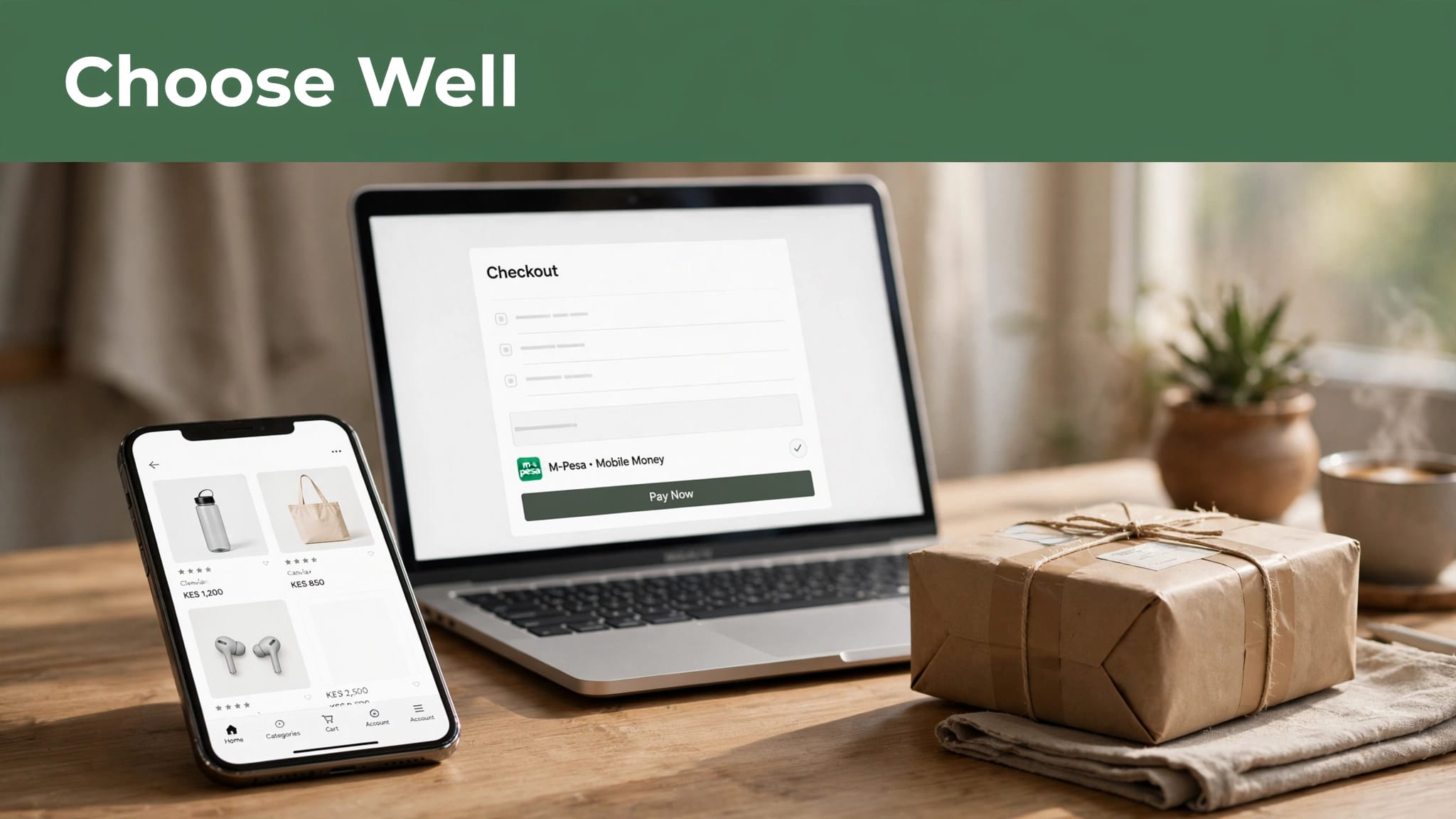
A website quote can sound simple until you ask what happens after the design is approved. A dependable developer should help you define the work, build the features you need, test the site, and explain who will manage it after launch.
When you compare Kenya website developers, focus on evidence and clear scope rather than a polished pitch. The right partner for a five-page company site may not be right for an online shop or custom booking system.
At Nairobi Web Experts, we provide website development, hosting, cybersecurity, and business solutions. We recommend starting with the job your website must do, then comparing developers against that brief.
Key Takeaways
- Choose a developer based on the work your site needs, not a vague promise to make it look modern.
- Ask for live portfolio links and test them on your phone. Check navigation, forms, speed, and calls to action.
- Compare written deliverables, ownership, support, and exclusions alongside the total project price.
- Published Kenyan prices offer examples, not a national average. Scope and included services differ.
- Agree on milestones, approval steps, content responsibilities, and a launch date before work begins.
- Make mobile usability, privacy, security, backups, and post-launch support part of the discussion.
What Website Developers in Kenya Do
A website developer plans and builds the parts that make a site useful. The work may include page structure, design, content management, forms, payment connections, speed improvements, testing, and maintenance. The right combination depends on what you want customers to do.
Design and development solve different problems
Design covers the way a site looks and how people move through it. Development covers how its features work, how content is stored, and how the site connects to other services. One person may handle both, while a larger team may divide the work among designers, developers, and project managers.
The terms overlap in everyday searches. Someone looking for Nairobi web designers may need a designer to plan a new layout, or a developer to repair an existing site. A useful provider will clarify which skills your job needs before promising a solution.
For example, a service business may need clear service pages, a contact form, a phone number, and a WhatsApp link. An online shop has more moving parts, including product listings, stock management, payment handling, order notifications, and delivery information.
Support is part of the work
A site may need updates after launch. These can include adding a page, fixing a broken form, updating software, or reviewing a slow page. Ask whether the project price includes support, how long that support lasts, and what the provider charges for work beyond the agreed scope.
A guide to website developers in Kenya can help you frame the scope and compare proposals. For web design Nairobi searches, the useful question is not only who can build the pages. It is who can deliver and support the whole setup you actually need.
Decide What the Website Must Do
Before requesting proposals, write down the job the website needs to perform. A clear goal gives developers something concrete to estimate and gives you a fair basis for comparing their answers.
Start with customer actions
List what visitors should be able to do. They might call, send an enquiry, request a quote, book an appointment, download a document, or buy a product. Then identify the pages and features required for each action.
A small consultancy may need a home page, service pages, an about page, case studies, and a contact form. A clinic may need service information, location details, and an appointment request. A shop may need categories, product pages, checkout, payment, and order updates.
Avoid asking for features because a competitor has them. Each feature adds decisions, development, testing, and sometimes ongoing costs. If a live chat tool will sit unanswered, a clear phone number and enquiry form may serve visitors better.
Separate essential work from later improvements
Divide your requirements into two groups: what the site needs at launch, and what can wait. This makes the first project easier to price and reduces the risk of scope expanding halfway through.
For instance, launch with core pages, a contact form, analytics, and a CMS that lets your team update basic information. Add a resource library or booking integration later if visitor behaviour shows a need.
Write down who will supply copy, photos, product details, and brand assets. Content delays can hold up design approval and launch. If you need copywriting or image sourcing, include that responsibility in the brief instead of assuming it comes with development.
Choose Between a Nairobi Team and a Remote Developer
A local provider can make communication and meetings easier, but location alone does not prove quality. Many projects work well remotely when responsibilities, review points, and communication channels are clear.
Local knowledge can shape useful details
A Nairobi developer may understand common local customer habits, such as browsing on a phone, using WhatsApp to ask questions, or expecting prices in Kenyan shillings. That familiarity can help shape contact options, mobile layouts, and payment choices.
However, a developer should still ask about your particular customers. A law firm, a food supplier, and a tourism business have different audiences and different reasons visitors trust them. Local understanding is useful when it leads to better decisions for your business, not when it becomes a generic promise.
People searching for web developers in Nairobi can compare local firms with independent specialists elsewhere in Kenya. Remote work is also common. What matters is whether the developer can explain the process, share progress, and make decisions with you at the agreed times.
Make communication practical
Before hiring, agree on how you will share feedback and how quickly each side should respond. Email may suit formal approvals, while a project tool or messaging app can handle routine updates. Keep final decisions and scope changes in a written record.
If you want an in-person meeting, choose a provider whose location and schedule make that practical. Nairobi Web Experts is based at Karen Plains Arcade in Nairobi. For web design services in Nairobi, the location can be convenient, but it should sit alongside a review of the portfolio, process, and contract.
Decide Whether to Hire a Freelancer or an Agency
Freelancers and agencies can both deliver good work. The best fit depends on the size of your project, the skills it needs, and how much coordination you want to manage yourself.
A freelancer can suit a defined project
A freelancer may be a good choice for a focused task, such as building a basic business site, designing page layouts, or improving a WordPress website. You may communicate directly with the person doing the work, which can make decisions quick.
The trade-off is capacity. If the project needs design, programming, copywriting, ecommerce, and ongoing support, one person may not cover every area. Ask who handles specialist work and what happens if the freelancer is unavailable during a critical stage.
An agency may coordinate several services
An agency can bring several roles together, which may help when the build includes design, development, hosting, security, and marketing. However, a bigger team does not automatically mean better results. Confirm who will be your point of contact and who is responsible for each deliverable.
Some searches for web development companies in Nairobi or web design companies in Nairobi turn up providers with very different team sizes and service models. Compare what each proposal actually includes. If your project is small and tightly defined, a large agency process may be more than you need. If it has multiple integrations, a team with the right specialists may reduce coordination work.
Assess Portfolios Beyond the Screenshots
A portfolio should show working websites, not only attractive mockups. Open the live links on your phone and use them as a customer would.
Test the path to action
Tap the menu, open key pages, and try the main action. Submit a form if it is clearly intended for public enquiries. Check whether phone links work, whether a shop’s product pages are easy to use, and whether a visitor can find prices or contact details without searching.
Notice how the layout behaves on a small screen. Text should remain readable, buttons should be easy to tap, and important information should not disappear below a crowded banner. Google uses the mobile version of a site for indexing and ranking, as explained in its mobile-first indexing guidance.
You can also compare the developer’s work with Google’s SEO Starter Guide. The guide covers search basics such as descriptive page titles and useful, crawlable content. A developer should not promise a particular search ranking, but they should be able to explain the technical foundations they will set up.
Look for relevant work and clear ownership
A portfolio is most useful when it includes projects similar to yours. If you sell products, inspect a real store. If you need bookings, look for a working booking flow. If your business depends on enquiries, assess the clarity of its forms and calls to action.
Ask who built each example and what the developer handled. A company may show a project where it only supplied graphics, while another provider did the coding. That distinction matters when you are hiring for technical development.
The phrase best web designers in Nairobi has no meaning without a project in mind. The strongest candidate for your business is the one whose work demonstrates relevant skills and whose process fits your needs. A portfolio should help you make that judgment, not replace it.
Set the Website Scope Before Comparing Quotes
A quote only makes sense when you know what it covers. Ask each provider to describe the same project in enough detail for you to compare like with like.

Make deliverables specific
A useful proposal should state the number and type of pages, the features being built, the platform, and the work included before launch. It should also identify what you need to provide, such as copy, photography, product details, or access to existing systems.
Clarify whether the quote includes responsive layouts, contact forms, analytics setup, basic search configuration, SSL setup, staff training, and migration of existing content. If these items are not listed, do not assume they are included.
For a broader view of website development services in Nairobi, it helps to break the job into planning, design, build, testing, and launch. You can then see whether a proposal covers the full process or only a portion of it.
Record what is outside the quote
Exclusions matter as much as inclusions. A fixed price may not include copywriting, premium plugins, payment gateway charges, photography, domain registration, hosting, or support after launch. Ask the provider to name the services that will incur separate fees.
Also define the revision process. A proposal should explain how many rounds of design changes are included and how the team handles a request that changes the agreed scope. This prevents a late feature request from turning into an unexpected charge or deadline change.
Understand Website Development Prices in Kenya
There is no single price for a website in Kenya. A basic site with a few pages requires less work than an online store or custom portal, and package descriptions vary. Treat published prices as examples of specific offers, not a national average.

Compare the details attached to a price
Kenya Website lists Basic Web Design at KSh 15,000, Business Web Design at KSh 30,000, ecommerce shopping website design at KSh 30,000, and multivendor ecommerce design at KSh 60,000. Its page was updated on 10 June 2026. The package names and prices do not, by themselves, describe all the pages, integrations, support, and exclusions involved. See Kenya Website’s listed design packages.
Kenya Web Designs lists its ROCK package at KSh 43,000 for a small business or personal site of up to 10 pages. Its VERSATILE package is KSh 80,000 for up to 50 pages, with more advanced database integration, content planning, and ecommerce. The page was reported updated on 27 February 2026. Review the Kenya Web Designs package details as one published comparison, not a universal benchmark.
Web.ke Offers lists a one-time Starter package at KSh 15,000 for up to five pages. Its stated inclusions include WordPress, responsive design, Google Analytics integration, and a WhatsApp chat button. It estimates five to seven business days and lists a 50% upfront, 50% on delivery payment structure. The page excludes several items, including a blog section, Google Maps integration, and priority support. Its Starter package listing shows why a low headline price needs to be read beside the scope.
Budget for more than the initial build
The total cost may include a domain, hosting, email, premium tools, content work, maintenance, and future feature changes. Ask for one-time charges and recurring charges separately. A low build fee can still lead to higher ongoing costs if hosting or support is not part of the package.
Our service list includes website development, domains and hosting, cybersecurity, SEO and advertising, cloud computing, and business solutions. We also outline web hosting in Kenya and domain registrars in Kenya for businesses planning those parts of a launch.
If you are researching a web designer salary in Kenya, remember that employee salary and a client project quote measure different things. A project fee can cover planning, tools, revisions, testing, communication, and support, not just the hours spent designing a page. Compare the deliverables and working arrangement instead of treating salary figures as a website price.
Agree on a Realistic Project Timeline
A launch date depends on scope, content, approvals, and the availability of everyone involved. A simple informational website can move faster than a store that needs product setup, checkout, payment testing, and delivery rules.
Break the work into stages
Ask the developer to show the project stages and what each one requires from you. A typical plan may include a briefing, page structure, design approval, development, content entry, testing, and launch. Each stage needs a clear owner and an approval point.

The timeline should reflect the agreed project rather than a generic promise. Ask what assumptions it depends on, such as receiving all text before development begins or getting feedback within a set number of days.
Keep delays from becoming surprises
Projects often slow down when content arrives late, approvals remain pending, or new features appear after work begins. Name one person on your side who can provide consolidated feedback. That helps prevent conflicting revisions from several staff members.
If a launch date matters for a campaign or event, state that at the start. Ask which features are essential for launch and which can follow later. A phased release can help when the basic site is ready but secondary features need more development and testing.
Prioritize Mobile Usability and Local Search
Many customers will first see your website on a phone. A layout that looks good on a large desktop screen can still be hard to use on mobile if text is tiny, buttons are crowded, or key information is buried.
Test the phone experience
Review the home page and the pages that drive enquiries or sales on a phone. Check whether visitors can find your services, location, opening hours, prices, and contact options. For shops, test the product journey through checkout rather than stopping at the product listing.
A local business may benefit from clear Nairobi service areas and a consistent business name, address, and contact information. Local search setup should match the places you actually serve. Mentioning neighbourhoods without a real service connection can confuse visitors and dilute the page.
The terms website designers in Nairobi Kenya, website designers Nairobi, and Nairobi website designers often describe the same broad search need. Your developer should still ask whether the website is for a Nairobi audience, a national audience, or both. That answer affects content structure and local search priorities.
Look for useful search setup
A developer can set page titles, clear headings, readable page addresses, and a structure that search engines can crawl. They can also connect analytics or Search Console so you can review traffic and search performance. Google describes Search Console as a way to measure search traffic and identify site issues.
Search setup is groundwork, not a promise of first-page rankings. Your business still needs useful pages, accurate information, and a way to keep content current. To plan a site around local services, use our Nairobi website guide for further planning.
Choose Services That Match Your Business
A website package should fit how your business operates. The right feature set for a consultant is different from the right set for a shop, school, or property company.
Business sites and service pages
A business site typically needs a clear home page, service or product information, an about page, contact details, and a direct way to enquire. Depending on the business, it may also need staff profiles, testimonials, case studies, locations, or downloadable forms.
If you need website design Nairobi services, ask how the developer will make the information easy to scan and update. A clean design should help customers understand what you offer and what to do next. It should not bury service details under decorative sections.
Businesses sometimes begin by looking for graphic design companies in Nairobi. Branding and graphic design can support a website, but visual identity work alone does not cover site development. Confirm whether the provider will build and test the website, or only supply graphics and page mockups.
Online stores and booking features
An ecommerce project needs more than a product grid. Ask about checkout, payment options, product variations, stock, delivery information, customer notifications, refunds, and order records. If you accept M-Pesa, clarify how the payment flow is connected and tested.
A shop that sells in person may need its website to work alongside existing stock or point-of-sale processes. A booking service may need calendars, confirmation emails, rescheduling, and staff access. Explain how the feature should work in everyday use, not only what you want it called.
Website design companies in Nairobi may have different strengths across brochure sites, ecommerce, and custom systems. Ask to see a working example of the specific feature you need. For M-Pesa payments, ask how the site handles a successful payment, a failed payment, and a delayed notification before accepting the build as complete.
Protect Ownership, Hosting, and Ongoing Support
A website should remain manageable after the developer completes the project. Before work starts, agree on who controls the domain, hosting account, administrator access, and website files.
Keep business accounts under your control
Your business should know where its domain is registered and who can access the hosting account. Ask the developer to explain how you will receive admin credentials and whether the site uses a content management system your staff can operate.
If an agency registers the domain or hosting for you, establish how ownership and transfer work. You should not have to depend on a single developer just to access your own site. The same applies to analytics accounts, email services, and paid plugins.
The phrase website designers in Nairobi can lead to providers with very different handover practices. Make account ownership a written deliverable, rather than a verbal assurance at the end of the project.
Define maintenance and recovery
Ask what happens after launch if a plugin update breaks a page, a form stops sending messages, or a site becomes unavailable. A maintenance agreement should name the tasks covered, response expectations, backups, and whether recovery work costs extra.

Security is ongoing work. Updates, access controls, backups, SSL, and recovery plans help protect the site, but the exact responsibilities should be clear. Our services include website hosting and cybersecurity, and we provide support options according to the requirements of a project.
Ask These Questions Before You Hire
A first conversation can reveal whether a developer understands your needs or is quoting before learning the details. Ask the same core questions of each shortlisted provider so you can compare the answers fairly.
Questions about the work
Ask who will design and build the site, which platform they recommend, and why it fits your requirements. Ask for live examples with similar features. If the project includes payments or bookings, ask how the team will test those flows before launch.
Clarify the expected page count, included features, content responsibilities, revision rounds, and what counts as a change in scope. Ask for the planned stages and approval points, along with the payment milestones. A provider should be able to explain these in plain language.
Questions about handover and support
Ask whether you will own the domain, hosting account, and site files. Find out how you will receive admin access and whether training is included. Ask which recurring fees apply and what happens when the support period ends.
You can also ask who handles routine updates, backups, security issues, and urgent fixes. A clear answer may be a maintenance agreement, an hourly rate, or a separate support package. The arrangement matters more than the label.
For a useful comparison, request a written proposal from each candidate. A proposal should make it easy to see the scope, exclusions, timing, price, responsibilities, and post-launch plan in one place.
Avoid Common Hiring Mistakes
A cheap quote is not automatically poor value, and a high quote is not proof of quality. The risk comes from choosing without understanding the work or agreeing to vague terms.
Watch for unclear promises
Be cautious when a provider promises top search rankings, gives a firm launch date without asking about requirements, or cannot explain what the price includes. A portfolio made only of screenshots makes it difficult to judge the live experience. A refusal to provide a preview during development can also leave you with little visibility.
Avoid paying for a project without written scope and milestones. The agreement should explain what happens if you change the brief, delay content, or ask for additional features. It should also state what you receive at handover.
Don’t overlook the people and tools involved
Ask whether the proposed build relies on licensed themes and plugins, and who pays recurring license costs. Find out how updates will be handled. A site built with tools that cannot be maintained may become expensive or vulnerable later.
If a provider handles design, hosting, security, and marketing, ask which of those services are part of your quote. The phrase web development companies in Kenya covers firms with very different offers. A provider that lists many services may still quote only for some of them.
Searches for web designers in Nairobi and website developers Nairobi can also surface branding studios, freelancers, and development teams. Distinguish their roles before comparing offers. If you need a graphic identity as well as a functioning website, put both needs in the brief and make sure the proposal names each deliverable.
Plan for Privacy and Payments
A website that collects personal information or accepts orders needs clear handling rules. Privacy and payment requirements should be discussed early, especially when forms gather customer details or the site connects to business systems.
Make data collection clear
If your website collects names, phone numbers, email addresses, or other personal information, explain what the data is for and who can access it. The Office of the Data Protection Commissioner provides FAQs on data protection and guidance relevant to businesses handling personal data.
Ask the developer what forms collect, where submissions are stored, and how access is managed. If you use third-party analytics, marketing tools, or embedded services, include them in the conversation. A privacy notice should reflect the tools and data practices your business actually uses.
Scope payment flows and invoicing
For online payments, define the customer journey and the business records you need. M-Pesa integration can involve a payment prompt, transaction status, order reference, customer notification, and reconciliation. Ask the developer to test the whole path, including an unsuccessful payment, rather than only the visible checkout button.
Separately, if your business is required to issue electronic tax invoices, the Kenya Revenue Authority provides information on eTIMS and electronic invoicing. Treat website checkout and tax invoicing as related but distinct requirements. A developer can discuss integration options, but the website scope should state which accounting or invoicing connection is included.
Frequently Asked Questions
How do I find a website developer in Nairobi?
Start with a written brief and shortlist providers whose portfolio includes work similar to yours. Test their live sites on a phone, then compare scope, timeline, fees, ownership, and support. The Nairobi website developers guide offers more local context.
How much does a website cost in Kenya?
Prices depend on page count, design, content, platform, integrations, and support. Published listings include examples at KSh 15,000, KSh 30,000, KSh 43,000, KSh 60,000, and KSh 80,000, but each listing has its own package scope. These examples are not a national price average. Compare the work included before you decide whether quotes are comparable.
How long does website development take?
The timeline depends on the site type and how quickly content and approvals are provided. A five-page brochure site has fewer moving parts than a store with products, checkout, and payment testing. Ask for a stage-by-stage schedule tied to your project rather than relying on a generic deadline.
Should I hire a web designer or a web developer?
Hire for the skills your project requires. A designer focuses on layout, visual identity, and user experience. A developer builds and connects the technical features. Many providers offer both, but the proposal should say who handles each part.
Can my team update the website after launch?
Yes, if the site uses a content management system and your team receives the right access and training. Confirm which pages you can edit, whether training is included, and what changes require developer support.
What should a website contract include?
It should state the deliverables, price, payment milestones, timeline, revision limits, content responsibilities, exclusions, ownership, access, and support terms. Clear terms make it easier for both sides to resolve questions during the project.
Choose a Developer by Fit, Not by a Slogan
The right website developer makes the project understandable before work begins. You should know what the site will do, what the price covers, how approvals work, and who will maintain it after launch.
When you compare proposals, give more weight to relevant live work, clear communication, mobile usability, and a practical handover than to broad claims. A website becomes a useful business asset when the build matches its purpose and your team can manage it.