To create a website in Kenya, you need a domain, hosting, useful content, and a platform that fits your business. If you’re hiring a Nairobi developer, I recommend agreeing on the pages, payments, ownership, and support before design begins.
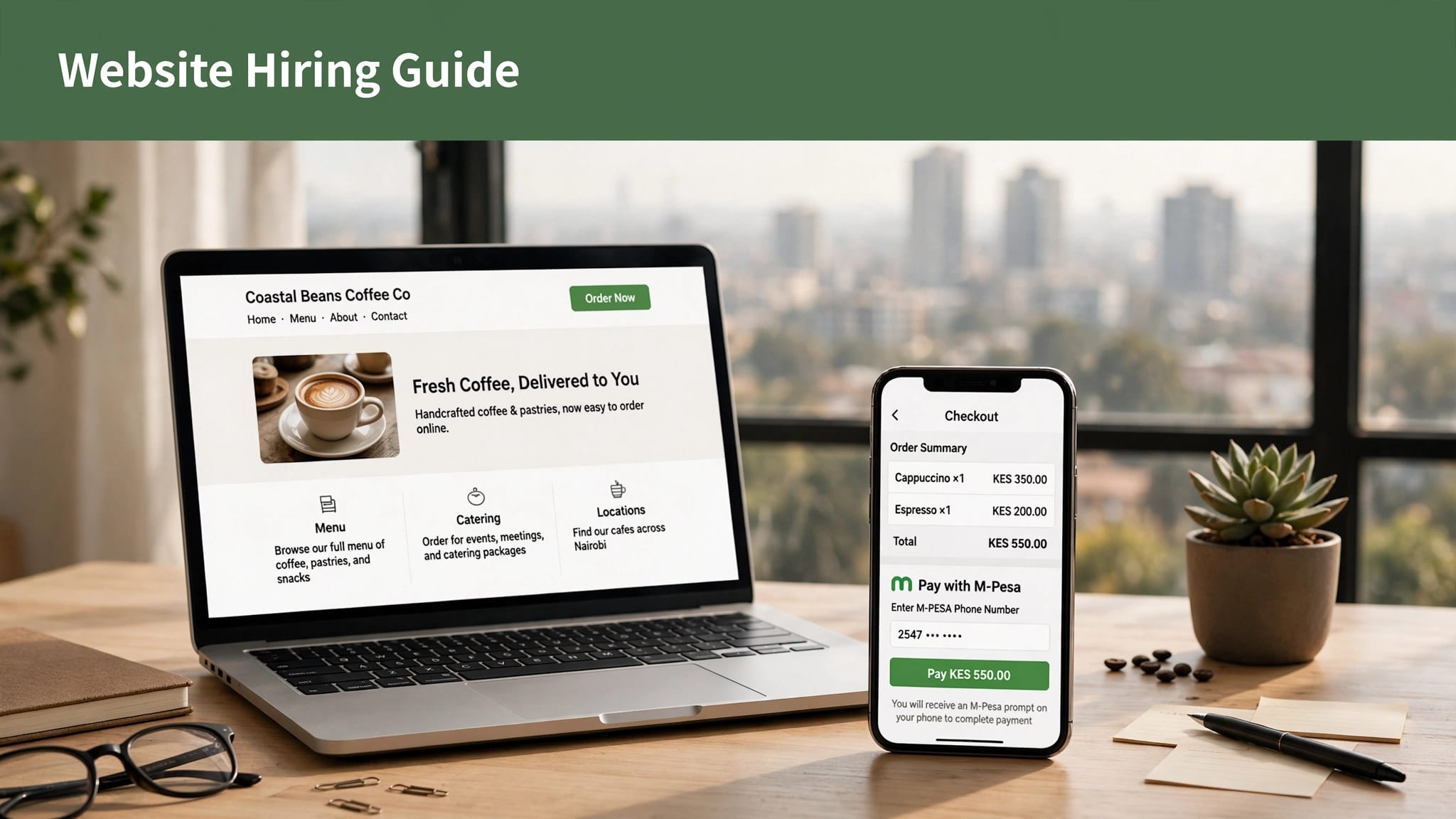
Your website must work on a small phone screen and make the next step obvious. A beautiful homepage won’t help if customers can’t request a quote or complete an M-Pesa payment.
Start with a clear business goal, then build the website around it.
Key Takeaways
- Choose the platform around your requirements. WordPress suits many business websites, while a custom application fits more demanding workflows.
- Compare complete proposals, including content, hosting renewals, payment integration, maintenance, and ownership.
- Make mobile browsing and M-Pesa payment handling part of the original scope, rather than late additions.
- Keep business control of your domain, administrative accounts, customer data, and website files.
I judge a website by whether customers can complete useful tasks without confusion. For a service business, that could mean sending a qualified inquiry. For a shop, it means finding an available product and receiving a reliable order confirmation.
That distinction should shape your budget, your choice of developer, and the features you commission.
Decide What the Website Must Accomplish
A website project becomes easier to manage when you can describe its purpose in one sentence. I recommend choosing one primary outcome before discussing colours, animations, or themes.
A law firm may need consultation inquiries. A retailer needs orders. A school needs clear admissions information, while a property business needs accurate listings and viewing requests. These requirements lead to different structures and development work.

Describe what happens after a visitor takes action, too. An inquiry form needs a recipient. A booking request needs someone responsible for replying. Online orders need stock handling and fulfilment.
Without those decisions, a website can collect requests that nobody follows up.
I also recommend identifying your customers’ practical constraints. They might browse during a commute, use mobile data, or need to discuss an order before paying. The Communications Authority’s reporting on Kenya’s mobile and data growth supports treating mobile access as a central design requirement.
Finally, choose a meaningful measure of success. Count completed inquiries, paid orders, or confirmed appointments rather than celebrating traffic alone.
Give your developer that measure at the start. It helps distinguish necessary features from attractive extras that consume the budget without helping customers.
Choose How to Create a Website in Kenya
The main routes are a hosted website builder, a content management system, or custom development. I wouldn’t choose between them on appearance alone.
Consider who will update the site, how payments work, and what happens when your requirements change.
Hosted Builders for Straightforward Websites
Wix, Squarespace, and Shopify provide hosted tools for building and managing websites. They reduce the infrastructure work because the platform handles much of the underlying environment.
A builder can suit a small brochure website or a store whose needs fit the platform. However, subscription charges, paid applications, and payment arrangements affect the ongoing cost.
I recommend deciding your required features before selecting a template. A polished demonstration doesn’t establish that a platform supports your exact delivery rules, customer accounts, or Kenyan payment flow.
WordPress for Flexible Business Websites
WordPress is a practical option for service websites, publications, and many online stores. WooCommerce adds e-commerce functions, including products, orders, and checkout.
The software gives you considerable control, but someone must maintain the hosting, themes, plugins, and backups. I prefer a modest set of dependable components over a crowded installation with overlapping features.
A WordPress proposal should identify who manages updates and who pays for commercial licences. It should also state whether you can edit ordinary content without hiring the developer again.
Custom Development for Special Workflows
Custom development makes sense when established tools don’t adequately handle your requirements. Examples include complex customer portals, unusual approval processes, or integrations with existing business systems.
However, custom code brings a longer-term responsibility for documentation, testing, and maintenance. I would reserve it for requirements that justify that additional work.
These options differ most in control and responsibility.
| Approach | Suitable Starting Point | Main Ongoing Consideration |
|---|---|---|
| Hosted builder | A straightforward site using established platform features | Subscriptions and platform restrictions |
| WordPress | A business website or configurable online store | Hosting, updates, and plugin maintenance |
| Custom development | A specialised portal or business application | Technical support and code maintenance |
The right choice is the simplest approach that can reliably support your business.
Write a Brief Before Requesting Quotations
A consistent brief makes proposals comparable. Without one, different web design companies in Nairobi may quote for entirely different projects.
I recommend describing your business, audience, main objective, required pages, and essential functions. Include your preferred launch period and explain which content is ready.
Be precise about quantities. “Upload products” could mean ten products or an entire catalogue with variations. “Create service pages” doesn’t establish whether the developer writes them or pastes in supplied text.
Separate launch requirements from later improvements. A first release may need service information and inquiries, while a customer portal can follow after the basic website proves useful.
The brief should also explain who approves the work. If several people can request changes independently, the project can lose direction.
For a school website, distinguish public admissions pages from private student records. For real estate, explain who adds listings and removes unavailable properties. For an online shop, describe stock updates, delivery areas, and refunds.
These operational details matter more than a long wish list of visual effects.
Our guide to web design and development services explains the difference between visual design, working functionality, and ongoing support.
I would also give every shortlisted provider the same brief. Otherwise, a cheaper quotation might simply omit work another company has included.
Keep the brief readable. A few clear pages with defined responsibilities can provide more direction than a large document filled with vague ambitions.
Choose a Domain You Can Keep
Your domain is the address customers remember and the foundation of your business email. I recommend choosing a short, readable name that matches your business identity.
A .co.ke address communicates a Kenyan connection. A .com address may suit a business with a broader international audience. Neither extension compensates for unclear content or poor service.
Choose the Extension Around Your Audience
KeNIC manages Kenya’s .ke namespace, while accredited registrars handle customer registrations.
Avoid unnecessary numbers, confusing spellings, and long strings of service keywords. Your domain should be easy to say during a phone conversation.
I wouldn’t use a misleading location or another organisation’s brand in a domain. A durable business name gives you more room to change services without replacing your address.
Our guide to domain registration in Kenya covers the registration options available to Kenyan businesses.
Keep Registration Under Business Control
The business should control the registrant details, account recovery email, and renewal arrangements. A developer can manage technical settings without becoming the practical owner of your address.
Use an email address you can access independently for account recovery. Otherwise, a problem with the website or business mailbox can also block access to the registrar.
I also recommend recording the renewal date and keeping billing contacts current. Domain registration is an ongoing commitment, even when the original website build was a one-time purchase.
First-year promotions and renewal prices are different costs. Budget around the recurring obligation rather than the cheapest introductory offer.
Select Hosting That Fits the Workload
Hosting keeps your website’s files and systems available online. The right package depends on the website’s software, traffic, storage needs, and business importance.
I wouldn’t buy hosting based only on a large storage figure. An active shop can need more capable processing than a brochure website with many photographs.

Match Resources to the Website
Shared hosting can be adequate for a modest business website. Managed hosting can reduce routine technical work, while a virtual private server offers more control and more management responsibility.
For planning, shared-hosting allowances of approximately KES 2,500 to KES 8,000 per year provide a starting range. These are estimates, not a universal tariff or a promise that every required feature is included.
A larger store, busy portal, or heavily customised application needs a workload-based hosting budget.
Server location alone doesn’t determine speed. Page weight, caching, software quality, and the route between the visitor and server also affect performance.
Define Backups, Email, and Support
A hosting proposal should state the backup schedule, retention period, and restoration process. A backup that nobody can restore offers little practical protection.
I also separate website hosting from business email requirements. Mailbox capacity, spam filtering, and account recovery deserve their own attention.
Find out who handles an outage and what support covers. Hosting support may address server availability without repairing broken website code.
Finally, keep copies of critical website files and database backups outside the live hosting account. That separation reduces dependence on a single account when something fails.
Design for Kenyan Customers on Phones
A desktop mockup can hide problems that become obvious on a phone. Navigation collapses, text wraps awkwardly, and checkout fields can become difficult to use.
I recommend approving the mobile experience alongside the desktop design. It should never be an afterthought.

Make the Main Task Easy
Visitors should quickly understand what you offer and how to proceed. Use readable text, clear navigation, and buttons that are comfortable to tap.
Keep forms short. An inquiry usually doesn’t need the same information as a delivery order.
For service businesses, tap-to-call and WhatsApp links can reduce friction. However, they need to reach the correct number and set realistic expectations about response times.
Google’s mobile-first indexing guidance also matters here. Google uses the mobile version of a site’s content for indexing and ranking.
Don’t remove useful service information from mobile pages merely to make the layout look cleaner.
Reduce the Cost of Loading Pages
Large photographs, autoplay video, and unnecessary scripts can make a website expensive and frustrating to browse.
I prefer properly sized images and restrained motion. A homepage doesn’t need a video background to explain a plumbing service or sell household goods.
Use modern image formats where supported, load off-screen images appropriately, and limit third-party widgets. Each added tool can increase page weight and introduce another dependency.
Test the product page, inquiry form, and checkout on an ordinary phone using mobile data. A homepage demonstration over office Wi-Fi doesn’t establish that the whole website works well.
Prepare Content That Helps Customers Decide
The website’s words should answer the questions people ask before contacting you. I recommend writing those answers before the final design locks into place.
Otherwise, the team may create attractive spaces that don’t fit the information your business needs to communicate.
Explain the Offer in Concrete Terms
Describe your services, delivery area, process, and relevant conditions. “Quality solutions” tells a customer less than a clear explanation of what you do and what happens next.
Give important services their own pages when they need distinct explanations. A single crowded page can make unrelated offers difficult to understand.
Use genuine photographs where possible, with permission from identifiable people. Avoid presenting stock photographs as your staff, premises, or completed projects.
For products, include accurate descriptions, available variations, and useful images. Customers shouldn’t need a phone conversation to discover basic specifications.
Establish Trust Without Inflated Claims
Show your trading name, contact details, and service area clearly. Add genuine qualifications or memberships only when they apply.
Testimonials need permission and truthful attribution. I wouldn’t publish invented reviews, unsupported customer counts, or claims of guaranteed business growth.
For an online shop, explain delivery, returns, cancellations, and refunds before payment. For appointments, describe whether a booking is confirmed immediately or awaits staff approval.
Also assign responsibility for keeping content current. Old prices, discontinued products, and expired application dates can make an otherwise functional website unreliable.
Before launch, read each page as a customer with a practical decision to make. Remove claims that sound impressive but leave the actual offer unclear.
Add M-Pesa With Reliable Payment Handling
For many Kenyan businesses, payment integration is a central part of the website. However, displaying a Till number and building an automated checkout are different pieces of work.
I recommend agreeing on the complete payment journey before the developer begins.

Choose the Payment Route
Safaricom’s Daraja Developer Portal provides access to M-PESA APIs for web and mobile integrations.
A direct integration gives your application responsibility for initiating supported requests and handling payment results. A payment gateway can offer another route, sometimes alongside card payments.
The proposal should identify the actual route, merchant account requirements, and responsibilities for integration support. Development charges and payment-processing charges belong in separate cost categories.
M-Pesa STK Push prompts the customer to authorise payment on their phone. Although the abbreviation overlaps, the SIM Application Toolkit, sometimes called the SIM card toolkit, is the phone’s SIM-based menu system.
Your website should never ask customers to enter their M-Pesa PIN into an ordinary web form.
Handle Success, Failure, and Delays
The website must connect a payment result to the correct order. It also needs to handle cancelled prompts, insufficient funds, timeouts, and delayed notifications.
A successful request to initiate payment isn’t proof that the customer paid.
A store should mark an order as paid only after receiving and validating the appropriate payment confirmation.
I would include duplicate notifications and interrupted checkout sessions in testing. Otherwise, a customer might pay successfully while the order remains unresolved.
Staff also need a reconciliation process. They should be able to relate an order to its payment reference and investigate mismatches without guessing.
If you offer bank transfer or cash on delivery, describe those workflows separately. Each option changes when an order becomes confirmed and when stock should be reserved.
Our guide to Kenyan e-commerce website development covers the wider relationship between checkout, stock, fulfilment, and customer communication.
Build a Realistic Website Budget
There isn’t one useful national price for creating a website. A short information site and a payment-enabled customer portal require different work.
I recommend comparing the total cost of ownership, including the expenses that continue after launch.
Use Estimates as Planning Ranges
For planning in October 2026, these broad development allowances help distinguish common project sizes. They are estimates, not fixed prices or Nairobi Web Experts package quotations.
| Website Type | Estimated Development Allowance | Typical Scope Direction |
|---|---|---|
| Basic information website | KES 20,000 to KES 50,000 | Core business information and inquiries |
| Standard SME website | KES 50,000 to KES 120,000 | More content, tailored layouts, and added functions |
| E-commerce website | KES 85,000 to KES 200,000 or more | Products, orders, checkout, and integrations |
The overlap between categories is normal. A content-heavy information website can require more work than a small, straightforward shop.
Custom applications need a separate specification because their workflows determine the development effort. A price range alone can’t describe the required security, integrations, or support.
Separate the Build From Recurring Costs
The development fee should state what design, implementation, testing, and revisions it covers. Content writing, photography, product entry, and migration may be separate work.
Recurring costs can include the domain, hosting, paid software licences, maintenance, email, and payment-processing services. Also distinguish setup fees from monthly or annual subscriptions.
A quotation should state whether applicable taxes are included. “KES per project,” “KES per month,” and “KES per year” create different commitments.
I would also budget for changes after launch. New services, revised delivery rules, and additional integrations require work even when the original website functions correctly.
Finally, avoid comparing headline prices without comparing quantities and responsibilities. A cheaper proposal that excludes content preparation, backups, and payment testing may leave you with a larger overall bill.
Choose the scope you can support comfortably, then expand when the business needs the next feature.
Choose Nairobi Website Designers by Project Fit
The best web designers in Nairobi for your project are the ones whose skills match the work. A strong portfolio matters, but so do clear explanations and dependable support arrangements.
I would compare a small shortlist using the same brief rather than collecting unrelated quotations.

Match Design and Development Skills
A web designer concentrates on visual structure and how visitors move through pages. A developer builds the working systems and integrations. Many providers handle both, but their strengths differ.
Graphic design companies in Nairobi may provide excellent branding without offering payment integration or server management. Define whether you need a logo, a website, or both.
For a complex store, look for evidence of order handling and checkout work. For an information website, assess content organisation and editing tools.
Web design courses in Nairobi and web design jobs relate to training and recruitment. Similarly, a web designer salary in Kenya or a web developer salary doesn’t establish the cost of an outsourced project.
Assess Working Methods and Support
Open portfolio websites on a phone and complete ordinary tasks. Look beyond the homepage to service pages, forms, and navigation.
Ask the candidate to explain their role in each relevant example. A project can involve several designers and developers.
Freelancers can suit focused work, while an agency may provide a wider mix of skills and support coverage. Neither structure guarantees a better result.
At Nairobi Web Experts, our services include website development, domains and hosting, cybersecurity, and business solutions. I recommend considering those responsibilities together when deciding who will build and support your website.
Our guide to choosing Nairobi website developers offers a deeper comparison of scope, ownership, and ongoing care.
Put Deliverables and Ownership in Writing
A written agreement gives both sides a shared definition of completion. I recommend settling this before paying for the main build.
The agreement should be readable enough that you can understand your obligations without interpreting technical shorthand.
Define Milestones and Acceptance
Break the project into meaningful stages, such as structure approval, design approval, development, testing, and handover.
Each stage needs a deliverable and a clear approval process. Payment milestones should relate to agreed progress rather than an unexplained calendar date.
Define the number of revision rounds and what counts as a new requirement. Changing a button colour differs from adding a booking system after development begins.
Also document content deadlines and the effect of delayed approvals. A developer can’t complete product pages while waiting for descriptions, prices, and photographs.
Protect Access and Exit Options
The contract should explain ownership of the completed work and any limits created by third-party licences.
You need appropriate access to the domain, hosting, content management system, analytics, and payment accounts. Keep privileged access restricted to the people who need it.
I also recommend documenting the handover materials. These can include administrative access, backup instructions, operating guidance, and relevant source files.
Distinguish a defect warranty from maintenance. Fixing an agreed feature that doesn’t work is different from adding a new feature or updating third-party software later.
Finally, state how the website can move to another provider. A workable exit arrangement protects continuity if the business relationship changes.
The goal is ordinary business control, without unnecessary dependence on one person’s account or memory.
Protect Customer Data and Plan Tax Invoicing
A website that collects names, phone numbers, or delivery addresses handles personal data. An online store also creates records that need to fit your business’s accounting process.
I treat these as launch requirements because adding them later can require changes to forms, software, and staff procedures.
Collect Only What the Business Needs
Kenya’s Data Protection Act, 2019 governs personal-data processing. The ODPC’s Personal Data Protection Handbook explains the framework and individuals’ privacy rights.
Your privacy notice should explain what you collect, why you collect it, and how people can exercise applicable rights.
Don’t request identification documents through a basic inquiry form without a genuine need. Limit staff access and define how long records remain available.
Registration obligations depend on the applicable rules and activities. Small size alone doesn’t justify assuming that every obligation disappears.
Where sensitive information or complex processing is involved, I recommend legal advice suited to the actual business.
Separate Payment Receipts From Tax Invoices
A website order confirmation, an M-Pesa message, and an electronic tax invoice perform different jobs.
KRA explains eTIMS and electronic tax invoicing as part of its invoicing framework.
KRA’s notice on invoicing by non-VAT-registered businesses also makes clear that electronic invoicing isn’t limited to VAT-registered traders.
Your website’s order records should fit an organised invoicing and reconciliation process. However, accepting payment online doesn’t by itself mean the public website needs a direct eTIMS integration.
I would define the accounting workflow with the person responsible for your books, then commission only the integration the business actually needs.
Build Search Visibility Into the Structure
A website needs useful pages that search engines can understand. I recommend planning this before launch rather than treating SEO as a collection of phrases added later.
For web design in Nairobi, that means describing the actual services, customers, and locations the business serves.
Give Each Important Service a Clear Page
Use descriptive page titles, logical headings, and readable addresses. Write service pages that answer real questions about the work.
If your business serves Nairobi and nearby areas, explain that accurately. Don’t create dozens of near-identical location pages that promise services you don’t provide.
Maintain consistent business contact details across your website and relevant business profiles. A phone number that differs between pages creates avoidable confusion.
For products, use distinct descriptions and useful category structures. Customers and search engines both benefit when related items are organised clearly.
Measure Inquiries and Sales
Google Search Console helps you understand search visibility and indexing. Google Analytics can help measure visitor activity when configured appropriately.
I recommend tracking meaningful actions, such as successful form submissions and completed purchases. A click on a payment button doesn’t prove a sale.
Connect measurement to your privacy choices and avoid collecting unnecessary personal information in analytics tools.
Also separate advertising work from website construction. A site can be technically ready for search without having an ongoing content or advertising programme.
Our website design services in Nairobi provide the foundation for bringing structure, usability, and hosting into one project.
Search visibility takes continued attention. Accurate content and a useful website provide a stronger base than promises of immediate first-place rankings.
Test the Website and Plan Its Care
Launch should follow acceptance testing, not merely the completion of a homepage. I recommend testing the functions that directly affect customers and staff.
A website can look finished while forms fail, payment notifications disappear, or order emails land in the wrong mailbox.
Run a Practical Launch Sequence
Use an ordered test process so important tasks don’t disappear beneath last-minute design changes.
- Review every page for accurate services, contacts, prices, and policies.
- Complete forms and confirm that the right person receives each submission.
- Test mobile navigation, checkout, payment failures, and order notifications.
- Restore a backup in an appropriate test environment and document recovery access.
- Confirm administrative ownership, staff training, and post-launch responsibilities.
Use test data carefully and remove unnecessary test records before opening the site to customers.
For an online store, include an end-to-end live payment test with an authorised transaction. Sandbox testing alone doesn’t demonstrate that production credentials and notifications work correctly.
Assign Maintenance Responsibilities
Website maintenance includes software updates, backups, monitoring, and investigating failures. It also includes ordinary content work, such as removing unavailable products.
The OWASP Top 10 identifies major categories of web application security risk. I use that framework as a reminder that security involves application design and access control, not an SSL certificate alone.
Enable multi-factor authentication where available and avoid shared administrator accounts. Give staff access appropriate to their roles.
A maintenance agreement should define response expectations and distinguish urgent failures from routine changes. “Support included” doesn’t explain who answers when checkout stops working.
Schedule periodic reviews of accounts, licences, backups, and key customer journeys. A website remains useful when someone owns its care after the launch celebration ends.
Frequently Asked Questions
How Much Does It Cost to Create a Website in Kenya?
For planning, a basic information website can fall around KES 20,000 to KES 50,000. A standard SME website may need KES 50,000 to KES 120,000, while e-commerce can require KES 85,000 to KES 200,000 or more.
These are broad development estimates. I recommend separating the build from hosting, domain renewals, content production, paid licences, and maintenance. An itemised scope makes those figures useful; a headline price without deliverables doesn’t.
Should a Small Business Use WordPress or Custom Development?
I would usually consider an established platform first when the requirements are ordinary service pages, inquiries, or a configurable shop. WordPress can provide an editable website without commissioning every component from scratch.
Custom development becomes more appropriate when the business needs unusual workflows or integrations that established tools don’t handle adequately. The decision should include maintenance and handover, because a custom application needs continued technical support. Choose around the work rather than the prestige of a particular technology.
Can a Website Accept M-Pesa Payments Automatically?
Yes. A website can use an appropriate integration to initiate payment and update orders after validated confirmation.
The important details are how the system handles payment results, delayed notifications, failed attempts, and reconciliation. I would require those behaviours in the project scope. Displaying a Till number can support manual payment, but it doesn’t automatically connect the payment to a website order. Automated checkout requires development and testing beyond adding payment instructions to a page.
What Should a Developer Hand Over at Completion?
The handover should include the agreed website, suitable administrative access, operating instructions, and clear ownership arrangements. Depending on the project, it should also include source files, backup procedures, integration documentation, and licence information.
I recommend a recorded or documented walkthrough for whoever will manage content and orders. The business should understand recurring charges and know who handles technical problems. Completion means the website can be operated and supported, with responsibilities clear to everyone involved.
Build a Website Your Business Can Operate
To create a website in Kenya, start with a clear purpose and commission the simplest reliable system that meets it. I would prioritise mobile usability, dependable payments, and business control over decorative extras.
Write a short brief, compare itemised proposals, and define handover before development begins. A useful website gives customers a clear next step and gives your team a manageable system behind it.