Choosing a website developer is a business decision: you need a site that works, a clear price, and support after launch. The best website developers in Kenya for your project are the ones whose portfolio, services, communication, and ongoing support match what you actually need.
A Nairobi brochure site, an online shop with M-Pesa checkout, and a custom booking platform require different skills and budgets. I recommend comparing providers against the same brief, then weighing what each proposal includes rather than relying on rankings or a low headline price.
Key Takeaways
- Compare providers on portfolio relevance, scope, price clarity, and support, not on a broad “best” label.
- Ask for examples that resemble your project, then test the live sites on a phone.
- Published prices are useful reference points, but they cover different scopes and billing models.
- A written proposal should explain what happens to your domain, content, code, hosting, and support after launch.
- Nairobi Web Experts lists Basic at KSh 25,000 per month and Professional at KSh 59,500 per month. Those are our published plan prices, not a market-wide rate.
What Makes a Website Developer a Good Fit?
A website developer turns your business goals into a site people can use. That work may include planning the pages, designing the interface, writing or configuring the code, setting up hosting, connecting forms or payments, and preparing the site for search engines.
However, providers package those tasks differently. A freelancer may focus on design and front-end development, while a development house may also offer hosting, cybersecurity, digital marketing, or custom software. Neither arrangement is automatically better. The right match depends on the features your business needs and the level of support you want.
Start With the Website’s Job
Before comparing developers, describe what the site should help you do. A professional services firm might need to explain its services and collect enquiries. A school may need admissions information, news, and downloadable forms. An online shop needs product pages, stock handling, payment options, and order notifications.
That purpose determines what belongs in the proposal. A quote that includes five pages and a contact form cannot be compared directly with one that includes a catalogue, payment integration, and training.
Look for Evidence, Not Superlatives
A claim such as “top agency” tells you little about the actual work. A portfolio can show whether a developer has built the kinds of pages, functions, or integrations your project requires. A written scope shows whether the provider understands the work.
I use five practical criteria when comparing options: portfolio quality, service fit, client feedback, pricing transparency, and post-launch support. Each gives you a different view of the relationship, so none should carry the whole decision alone.
Two people working together at a laptop with a caption reading Choose a Developer.
Website Developers in Kenya: A Practical Shortlist
There is no single verified ranking that establishes one developer as the best choice for every Kenyan business. The providers below offer different evidence, services, and published pricing. Use the comparison to create a shortlist, not as a league table.
Agencies With Named Portfolio Examples
Devure Technologies describes tailored web design and development. Its portfolio names projects including Afribeauty, NjiwaHub, Bera Prime Movers (K) LTD, Strategic Green Innovations, and Essyphere Public Relations. That gives you concrete examples to inspect when you are looking for a developer with project work across different businesses.
Tukoweb Solutions describes web development alongside AI, mobile apps, cloud, and digital solutions. Its portfolio includes Hangout Safaris CRM System, Safaris by Max Booking Website, and Africa Unadorned Safaris Website. The company lists an address at Senteu Plaza on Galana Road in Nairobi and claims more than 200 completed projects.
Webtech Solutions also names organisations and projects in its portfolio, including Cenacle Kenya, the Africa Center for Human Rights, Insurance Institute of East Africa, and Odhiambo & Kathyaka Advocates. Named examples are a starting point for evaluation, not proof that a provider has produced a specific business result.
Providers With Published Price Information
Mocky Digital lists Nairobi website design starting at KES 15,000. Its available Nairobi services page does not establish the scope behind every possible project, so treat that figure as an entry price rather than a like-for-like quote for a custom site.
MM Digital Marketing Kenya publishes ranges of KSh 60,000 to KSh 150,000 for a starter website, KSh 150,000 to KSh 400,000 for a business site, and KSh 300,000 to KSh 1,000,000 or more for e-commerce or custom work. Those broad bands signal that the feature set matters.
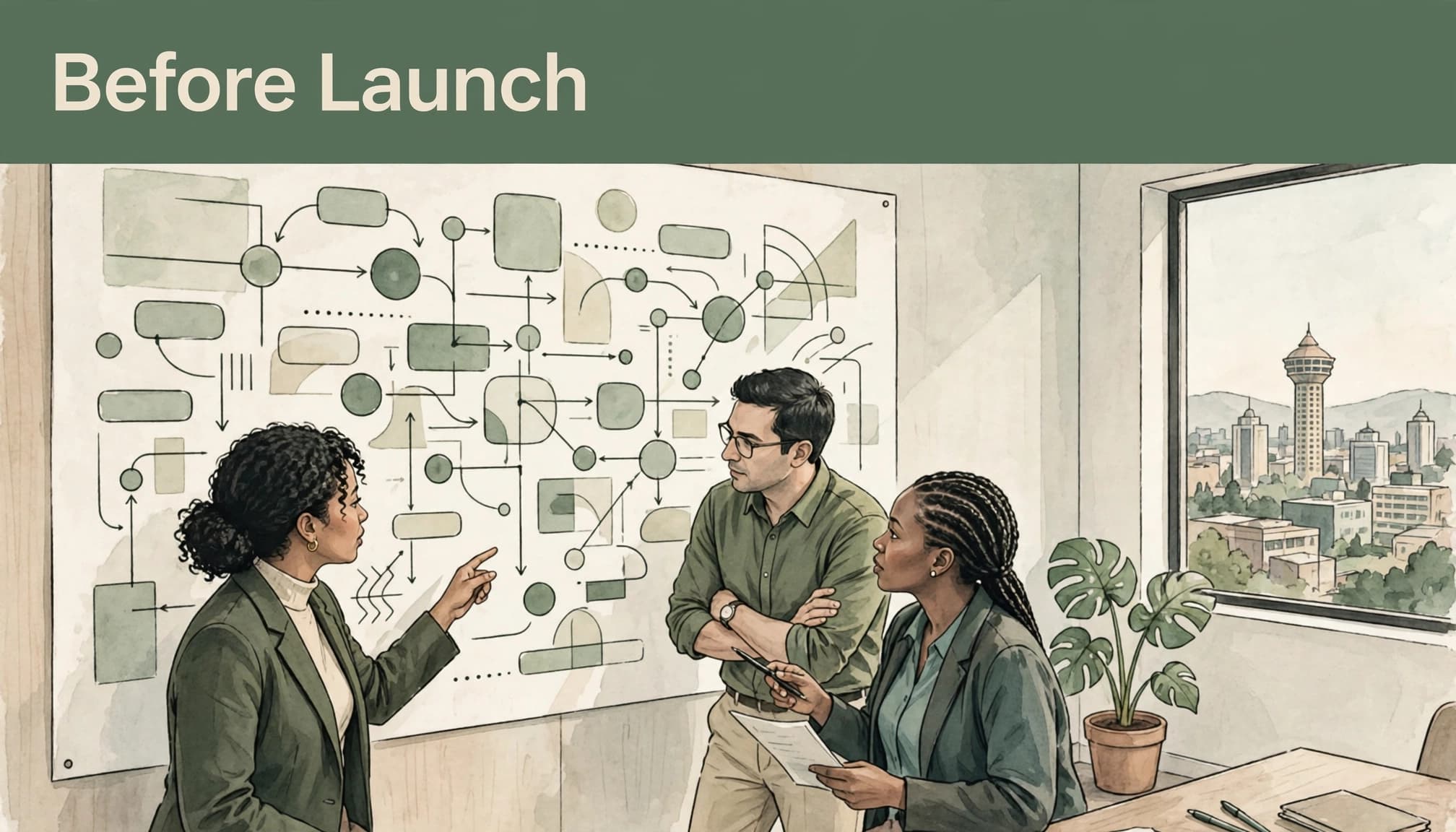
Illustration of three people reviewing a diagram in a meeting room with the headline Before Launch.
Comparing Nairobi Web Developers Side by Side
Nairobi web designers and developers can work across very different project types. This table separates the available evidence into services, published pricing, and location so you can see where each provider may merit a closer look.
| Provider | Publicly described work or evidence | Published price information | Location information |
|---|---|---|---|
| Nairobi Web Experts | Web development, hosting, cybersecurity, business solutions, SEO and advertising, cloud computing, and IT governance | Basic: KSh 25,000/month; Professional: KSh 59,500/month | Karen Plains Arcade, Nairobi |
| Devure Technologies | Tailored web design and development; named portfolio projects | No published price in the available portfolio information | Not stated in the available portfolio information |
| Tukoweb Solutions | Web development, AI, mobile apps, cloud, and digital solutions; named projects and a claim of 200+ completed projects | No published price in the available portfolio information | Senteu Plaza, Galana Road, Nairobi |
| Mocky Digital | Website design services in Nairobi | Starts at KES 15,000 | Nairobi, Kenya |
| MM Digital Marketing Kenya | Digital marketing and website services; published website pricing guide | KSh 60,000–150,000 starter; KSh 150,000–400,000 business; KSh 300,000–1,000,000+ e-commerce or custom | Westlands Commercial Centre, Ring Road Parklands, Nairobi |
| Webtech Solutions | Named client and project examples in its portfolio | No published price in the available portfolio information | Not stated in the available portfolio information |
The table does not compare identical services. A monthly package, a starting price, and a broad project range are different kinds of offers. For that reason, use these details to frame questions, then compare proposals that cover the same pages, features, content, and support.
If you want a Nairobi-specific overview of provider selection, our guide to website developers in Nairobi explains the local service mix and selection considerations.
How to Assess a Developer’s Portfolio
A portfolio should help you judge the work, not merely decorate a sales page. Start with two or three examples that share something with your project, such as an online store, a booking system, a professional services site, or a content-heavy organisation.
Open each live example on a phone. Check whether the menu is easy to use, the important information is visible without excessive scrolling, and buttons lead to the action you expect. Then try the same site on a laptop. A responsive design should remain clear and usable across screen sizes.
Check the Work Behind the Screenshots
Screenshots can show colour, layout, and style, but they cannot tell you whether a site is working well. If the developer provides a live link, test the forms, navigation, search, and any customer-facing features. On an online store, inspect a product page and the visible checkout steps.
Also ask what the developer contributed. A portfolio entry might show a design concept, a full build, or only one part of a larger project. Knowing the role helps you assess whether the provider has handled the technical and delivery work you need.
Look for Relevance and Range
A developer who has built a booking system may be a more suitable fit for a tour company than one whose portfolio is made up only of brochure sites. Conversely, a small business that needs five clear pages may not benefit from hiring a team whose strongest work is complex custom platforms.
Portfolio quality is not only about visual polish. Look for readable content, sensible navigation, fast-feeling pages, and a consistent path to contact or purchase. Our guide to website design services in Nairobi covers how design decisions connect to the needs of a business website.

Match Services to Your Project
The phrase web design Nairobi can refer to anything from a visual refresh to a complete website build. Before you choose a provider, establish whether you need design, development, hosting, content support, marketing, or a combination.
A web designer focuses on how the site looks and how visitors move through it. A developer handles the implementation, integrations, and technical behaviour. Many providers do both, but the proposal should say who owns each task. Graphic design companies in Nairobi may also be able to create logos, brand systems, or campaign artwork, but those services do not automatically include website development.
Decide Which Capabilities Matter
For a standard business site, you may need a content management system, responsive layouts, enquiry forms, basic analytics, and help connecting a domain. An online store needs additional decisions around product management, inventory, payments, shipping, and order emails.
For a custom platform, the brief could include user accounts, dashboards, booking logic, or links to other software. These requirements can change the project’s price and schedule. Ask the provider to distinguish standard features from custom development so you can see what drives the quote.
Keep Marketing Services Distinct
Search engine optimisation, paid advertising, social media campaigns, and website development are related but separate services. A developer can build a site with crawlable pages and sound technical foundations, but that does not mean ongoing SEO or advertising management is included.
Google’s SEO Starter Guide explains how site owners can make pages easier for search engines to crawl, index, and understand. If a proposal includes SEO, ask whether it covers basic setup, content planning, ongoing optimisation, or reporting. Those are different scopes.
Website Development Costs in Kenya
Website prices vary because projects vary. A simple brochure site with several pages does not need the same planning and build effort as a custom portal or an online shop with payments. Comparing prices without comparing scope can make a reasonable quote appear expensive, or a low quote look more complete than it is.
The published figures in the shortlist give useful reference points, not a fixed national rate. Nairobi Web Experts lists a Basic plan at KSh 25,000 per month and a Professional plan at KSh 59,500 per month. MM Digital Marketing Kenya publishes separate ranges for starter, business, and e-commerce or custom websites. Mocky Digital lists website design starting at KES 15,000. These offers are not directly interchangeable.
What Changes the Price?
Costs usually depend on the number of pages, the level of custom design, and the amount of content work. Integrations such as payments, booking tools, customer accounts, or inventory management add work beyond a basic information site. Copywriting, photography, translation, and data entry can also affect the total.
Time matters too. A tight deadline may require a different staffing plan. Likewise, a site that needs original design and custom functionality typically calls for more work than a setup built from a standard theme.
Compare the Full Cost
A quote should distinguish the build cost from recurring services. Hosting, domain renewal, business email, software licences, maintenance, and support may be billed separately or included in a package. Ask for the first-year total and the expected recurring charges, where those figures are available.
Our published Basic plan includes a domain and hosting, up to five business email accounts, up to 15 pages, a content management system, SSL, and analytics integration, with stated delivery in 10 working days. Professional includes up to 15 business email accounts, up to 35 pages, basic SEO setup, online payments and donations, and stated delivery in 15 working days. We list these as monthly plans, so compare their included work and billing period with project-based quotes.
Scope and Cost text over modular cards, a site map, a calculator, and a coin on a tabletop.
What Pricing Transparency Looks Like
A clear price is more than a number on a proposal. It should show what the developer will deliver, what you need to provide, and which costs recur after launch. If a quote says “website development” without defining the pages or features, you cannot make a useful comparison.
I recommend asking each shortlisted provider to price the same brief. Include the expected page count, the core functions, whether you need help with copy or images, and whether the site needs hosting or maintenance. Then compare the final scope and exclusions, not just the total.
Ask About Assumptions and Exclusions
A proposal may assume you will supply all text, product information, and photographs. Another provider may include content support or product uploads. Those differences can affect both budget and workload, even when the final page count is similar.
Ask whether the quote includes revisions, testing, training, domain setup, migration from an existing site, and launch support. If those items are excluded, ask for them to be listed separately. That makes it easier to understand the total project cost without relying on vague promises.
Avoid Comparing a Package to a Custom Build
A package can suit a business with standard requirements and a defined scope. Custom development is usually priced around the specific functionality and work involved. Neither format is inherently more economical, because the number and type of deliverables matter.
For more detail on how Kenyan web development quotes differ, our website development guide for Kenyan businesses discusses costs, project questions, and common scope issues.
How to Evaluate Client Reviews
Reviews can help you understand how a provider communicates and handles the work around a build. Read for details rather than relying on a single star rating. Useful feedback may mention how the team handled revisions, explained technical decisions, or responded when a problem appeared.
The available public information used for this comparison does not establish independent review scores or review counts for the listed providers. I therefore avoid assigning ratings or presenting the shortlist as a customer-voted ranking. You can still assess the quality of the evidence a provider shares.
Read for Specifics
A detailed review gives context about the project and the working relationship. A short testimonial that says only “great service” gives little information about deadlines, scope, or results. Look for comments that describe what the client hired the provider to do and how the provider handled the work.
When you speak with a provider, ask whether they can share a relevant reference or explain a completed project similar to yours. A reference is most useful when you ask focused questions about communication, changes, and support after launch.
Separate Testimonials From Performance Claims
A review may describe a positive experience, but it does not prove that a website increased sales or improved search rankings. Those outcomes depend on factors beyond the initial build, including the offer, content, traffic, and follow-up.
If a provider makes a performance claim, ask what was measured, over what period, and whether the result relates to a site similar to yours. A sound conversation keeps the claim connected to evidence and avoids treating every positive comment as a guarantee.
What Nairobi Buyers Should Consider
People searching for web designers in Nairobi often want a provider who understands local business needs and can communicate clearly. Location can help with meetings and coordination, but it does not replace a strong portfolio or a clear scope. Many parts of a website project can also be managed remotely.
If you are comparing Nairobi website designers, look at whether the provider can build for the way your customers actually use the site. Mobile performance matters, as does clear contact information and a path to the next action. For a local business, the site should make it easy to find services, understand where the business operates, and get in touch.
Domain and Local Identity
A local domain can make the business feel familiar to Kenyan visitors. KeNIC administers and manages Kenya’s .ke domain space. The KeNIC registry is the source for information about .ke domains, and its WHOIS service can help with domain registration information.
A website developer can help connect a domain to hosting and configure the site. Make sure you know who controls the registrar account and domain details. A company website is a long-term business asset, so ownership should be clear from the start.
Local Service and Communication
A Nairobi developer may be easier to meet in person, but a local address does not tell you how the project will be managed. Ask who your main contact will be, how feedback is collected, and how often you will receive updates.
If you search “development house Nairobi location,” you are looking for a location detail, not necessarily evidence of technical quality. Treat a physical address as one useful piece of information alongside the portfolio, proposal, and support terms.
Online Stores and M-Pesa Integration
An e-commerce website has to do more than display products. It needs to help customers find the right item, understand its price, complete payment, and receive a clear confirmation. The developer should explain how the store handles stock, order updates, refunds, and customer questions.
If your customers pay by M-Pesa, discuss the exact payment flow before the build starts. An M-Pesa STK Push is a website payment integration. It is different from a phone’s SIM Application Toolkit menu, which is also shortened to STK. If you came to the page searching for “simcard tool kit” or “STK,” check which meaning you need before asking for a feature.

Map the Customer’s Checkout
Ask the developer to walk through the full customer journey: product selection, cart, payment prompt, confirmation, and order notification. The team should also explain what happens if a payment fails or a customer closes the page before completing the transaction.
The scope should say which party supplies merchant or payment credentials and who handles testing. If you need refunds, delivery calculations, or a connection to stock software, write those requirements down. A site that accepts payment but leaves orders difficult to track is not a complete solution for the business.
Plan for the Work After Purchase
Store owners need a straightforward way to add products and adjust availability. Find out whether your staff can update listings without calling a developer each time. Ask for training and a test run using the actual process you expect to follow.
For a small retailer, a limited catalogue with a clear checkout may be enough. A larger store may need categories, filters, customer accounts, shipping rules, and integrations. Set the first release around what customers need now, and define any later features separately.
Hosting, Security, and Ongoing Support
A website needs care after it goes live. Hosting keeps the files and services available, while maintenance may cover updates, backups, security checks, and technical changes. The developer’s proposal should make clear which tasks are included and who handles them.
Nairobi Web Experts lists hosting, cybersecurity, cloud computing, and IT governance among its services. Other providers may offer a different mix, so look for the specific support your website will depend on. The best arrangement is one where responsibilities are clear, rather than a broad promise to “maintain the site.”
Ask What Support Covers
Support can mean anything from answering occasional questions to monitoring a site and fixing technical faults. Ask what the provider counts as routine maintenance, how requests are handled, and whether work outside the package carries an extra charge.
Also clarify how backups are created and how restoration works if the site breaks. A business site can lose enquiries while offline, and an online store can lose orders. A written process helps you understand who responds and what actions are available.
Protect Access and Ownership
Your business should retain access to its domain, hosting, content, and key administrator accounts. Ask how the developer will hand those over and whether the site can be moved to another host if your needs change. Ownership and access should not depend on informal assurances.
A security plan should address updates, passwords, access permissions, and backup recovery. If you need help after an incident, our page on website security services in Nairobi describes the kind of recovery and protection work a business may need.

SEO, Accessibility, and Customer Data
A well-built website should make it easy for people to find and use the information they need. Search visibility, accessibility, and privacy all affect how a site works for visitors. They should be part of the project discussion rather than afterthoughts.
Ask what the developer means when a proposal says “SEO included.” Basic technical setup might involve page titles, clean URLs, and a site structure that search engines can understand. Ongoing content planning, link building, or paid promotion are separate services and should be described separately.
Make the Site Usable for More People
Accessibility includes clear structure, readable contrast, keyboard access, and helpful labels for controls and images. These details can improve the experience for people using assistive technology and for visitors navigating on different devices.
The WCAG 2.2 guidelines set out recognised criteria for making web content more accessible. You can ask a developer how accessibility is handled in design and testing, especially if the website serves the public or provides essential information.
Treat Personal Information Carefully
Contact forms, analytics, user accounts, and payment flows can involve personal information. Discuss what data the site collects, why it collects it, how it is stored, and who can access it. The project may need clear privacy information and responsible handling of customer enquiries.
Kenya’s Data Protection Act applies to personal data processing. The available explanations from Ardent Privacy and WKA’s guide to Kenyan data privacy offer context on compliance considerations. A developer can implement technical features, but your business remains responsible for its own data practices.
Write a Useful Project Brief
A short, clear brief helps developers give you comparable proposals. It does not need technical language. Explain what your business does, who the website serves, what visitors should do, and what content or functions the site needs.
Start with the core pages and actions. A service business might need a homepage, service pages, about page, contact page, and enquiry form. An online store might need categories, product pages, cart, checkout, and order notifications. Add requirements only when they solve a real business need.
Include Content and Timing
Say whether you will provide copy, images, product details, and branding. If the developer is expected to create or organise content, include that in the scope. Missing content often delays a build, even when the technical work is progressing.
Set a realistic target date and note any fixed events, such as a campaign or product launch. Ask the provider to identify the work that must happen before launch and the decisions you need to make along the way. A schedule is more useful when it shows dependencies, not only a final date.
Ask for a Written Deliverables List
Your brief should help each provider respond to the same project. Ask for the page count, features, integrations, design approach, testing, training, and post-launch support to appear in writing. If you need a content management system, specify who will show your staff how to use it.
This is especially useful when you compare a freelancer, an agency, and a larger development house. Their process may differ, but each should be able to describe the work and the expected result in plain language.
Agree on Ownership, Revisions, and Handover
A proposal should explain the project relationship as well as the build. Before work starts, clarify who owns the website files, copy, images, domain, and administrator accounts. If a paid theme, plugin, or other licence is involved, ask who holds the licence and what happens when the contract ends.
The agreement should also describe the feedback process. Define how many review rounds are included, how you will submit changes, and what counts as a new feature. That distinction prevents a small visual revision from turning into a disagreement over scope.
Put Acceptance and Payment Milestones in Writing
A milestone plan can connect payments to visible progress, such as approved design, working development build, testing, and launch. The schedule should reflect the project’s size. Avoid paying for a vague promise without a clear list of deliverables.
Set out how you will approve the work. You might agree that pages and forms need to work on agreed devices, that supplied content is in place, and that training has been delivered. Clear acceptance criteria make the final review less subjective.
Plan the Handover
A good handover gives your team access and basic confidence managing the site. Ask for account details, a list of key integrations, instructions for common updates, and a contact path for future support. If the site uses a content management system, request a short demonstration of everyday tasks.
Before launch, test the contact form, links, mobile layouts, payment flow if applicable, and any user sign-up process. The developer should also explain the backup and recovery plan. Once the site is live, agree on who monitors it and how you will handle future changes.
Related Searches That Point to Different Needs
Some searches around web design Nairobi are about hiring a provider. Others point to training or careers. If you are looking for web design courses in Nairobi, you want a learning programme, not a developer to build your business site. Likewise, web design jobs in Nairobi and a web designer salary in Kenya relate to employment and pay rather than agency selection.
A search for graphic design companies in Nairobi may lead to branding or visual design providers. That can be useful if you need a logo or marketing material, but confirm whether the company also builds websites. A graphic designer and a web developer may collaborate, yet the skill sets are not identical.
You may also see variations such as Nairobi website designers, website designers in Nairobi Kenya, or website developers in Nairobi. Those phrases can all lead to providers, but the wording alone does not show whether the person handles coding, hosting, support, or only visual design. Check the listed services and portfolio against the work you need.
Frequently Asked Questions
How Do I Choose Among Website Developers in Nairobi?
Start with a short, consistent brief. Compare relevant portfolio examples, the services included, the price structure, the proposed timeline, and ongoing support. Then ask how the developer handles ownership, testing, revisions, and handover. A provider that explains these details clearly is easier to assess than one relying on broad claims.
How Much Does a Website Cost in Nairobi?
Published prices vary by provider and scope. The providers compared here publish a starting price of KES 15,000, monthly plans of KSh 25,000 and KSh 59,500, and project ranges that extend from KSh 60,000 to KSh 1,000,000 or more. Those figures cover different offers, so compare the features and billing period before drawing conclusions.
Should I Hire a Freelancer or a Web Development Company?
A freelancer may be suitable for a defined project with a limited scope and one main point of contact. A company may offer a wider range of services or more than one specialist. Your decision should depend on the work required, the provider’s relevant examples, and the support arrangement after launch.
What Should a Website Development Quote Include?
A useful quote describes pages, design and development work, features, integrations, content responsibilities, testing, revisions, delivery schedule, payment milestones, and any recurring costs. It should also state what is excluded. Without those details, two totals can appear comparable while covering very different work.
Can I Use M-Pesa on My Website?
Yes, a developer can build an M-Pesa payment flow into an e-commerce or other transaction-focused website. Define the customer journey, payment confirmation, order handling, and failure process before the build. Also distinguish M-Pesa STK Push from a phone’s SIM Application Toolkit menu, since STK can refer to both.
Choose a Developer by Fit, Not by a Label
The best website developers Kenya has to offer will not all suit the same project. A strong match is a provider whose portfolio supports your needs, whose proposal explains the full scope, and whose support terms make sense for your business.
Compare like with like, keep ownership clear, and treat the launch as the start of the website’s life rather than the end of the project. That approach gives you a better basis for choosing a developer you can work with beyond the first version.